Five Abstract Film Exercises
John and James Whitney, 1941-1944
The text and video excerpt below document the book by Philippe Langlois, Les cloches d’Atlantis, musique électroacoustique et cinéma archéologie et histoire d’un art sonore, éditions mf, Paris, first quarter 2012.
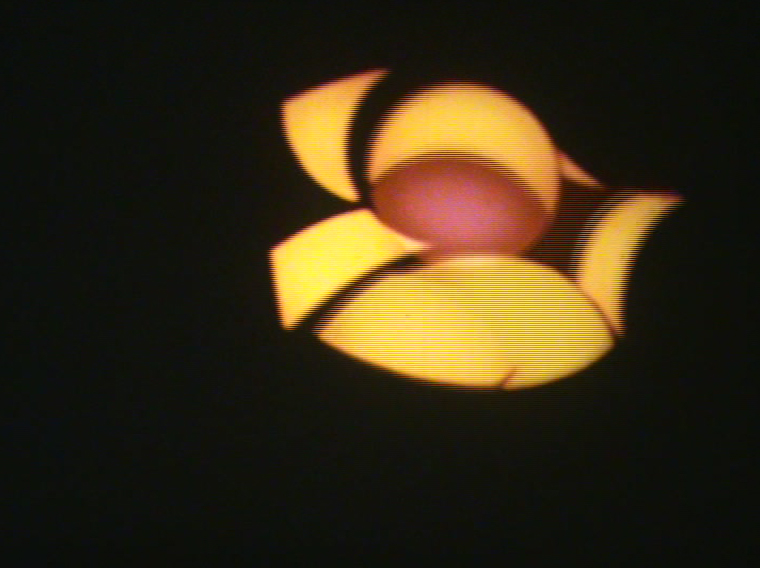
In the following years, John and James Whitney co-directed a series of five short films, Five Abstract Film Exercices, (1942-1945), which radicalises the notion of synaesthesia thanks to an apparatus invented by John Whitney, combining an optical printer with a calibrated pendulum rig. The great innovation of this apparatus lies in its capacity to create images and sounds simultaneously.
The Five Abstract Film Exercices are in several respects revolutionary and prophetic of what video art would be capable of engendering forty years later. Their first screenings took place at the Experimental Film Festival in Brussels in 1949, where they won the “special prize” thanks to the impact of the soundtrack, and struck the spectators with the overwhelming “electronic”, “supraterrestrial” music and the luminous “neon” images that seemed to have “fallen into our temporal sphere from the future of science fiction”. Obtained by means of prisms, multiple exposures and saturated, coloured gelatine filters, the images belong to visual abstraction and resemble coloured patches transforming themselves in a play of very vivid colours.
The avant-garde aesthetic that emerges from the Five Abstract Film Exercices comes not only from the highly innovative tonality of the visual treatment, but also from the way the soundtrack was created. The development and deployment of the geometric forms follow musical principles: for example, the fifth film in the series develops as a canon.
See Philippe Langlois’s article on John and James Whitney on the site Pionniers et précurseurs