La Belle cérébrale
Peter Foldès, 1968
The text and video excerpt below document the book by Philippe Langlois, Les cloches d’Atlantis, Musique électroacoustique et cinéma, Archéologie et histoire d’un art sonore, éditions mf, Paris, 2012.
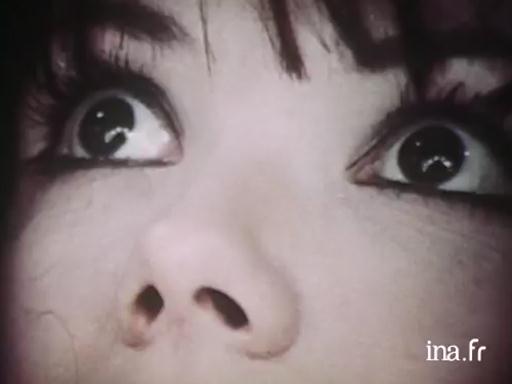
What do painters’ models dream of during their breaks? The fantasy universe of a young girl preoccupied with her beauty alone… A mixture of live-action footage, animation and video effects. La belle cérébrale is an undressed fashion model whom Peter FOLDES’s camera caresses like a foreign body. Indifferent to what surrounds her, this woman is bored. She seems not to hear the vulgar conversation of two men who are eating while waiting for a certain Léopold whom we shall never see, any more than she hears the radio broadcasting a distressing report. To amuse herself, she does her nails, then begins to dream. An imaginary world soon replaces reality, in which various objects: sweets, glasses of wine, telephone, flowers, jewels, wig, take hold of her and occupy her in turn; objects of desire to which frame-by-frame animation gives a total independence of movement. Then the woman dreams of dance and, to music by François BAYLE, her body, split in two in decomposed colours, is reflected and multiplies as in a kaleidoscope. After paroxysmal images, the woman’s face jerked about by the violent images of a spy film, a voice brings her back to the harsh reality of the model’s trade: she must smile and take up the pose again for a canvas that extols “the flower toothpaste”.
From the first notes of the credits, the music of François Bayle places us at once in a musical era that saw the public acclaim the Jerks électroniques of Pierre Henry and Michel Colombier, taken from the Messe pour le temps présent by Maurice Béjard in 1967.
In the revolutionary, protesting social climate of the late 1960s, musique concrète, an emanation of the purest musical research, seeks to popularise itself and to draw closer to a wider public, not only by multiplying experiments in applied music, whether for cinema, theatre, ballets, mime shows, puppet shows, etc., but also by resorting to an increasingly frequent musical cross-breeding, in particular with jazz, pop music or psychedelic rock.
After Luc Perini and Bernard Parmegiani, François Bayle thus in turn, and happily, seizes upon the contrast that results from the marriage of the off-kilter universes of musique concrète with pop/psychedelic-rock sonorities.
In this film, whose image ultimately shows only the figure of the female model, sound holds an essential place in generating a whole delirious musical universe through an off-screen sound field of the richest and most delicate kind.
This information notice was co-produced with INA/GRM for the creation of the multimedia fresco – Artsonores – L’aventure électroacoustique, in the category Films produced by the Service de la Recherche de l’ORTF from 1950 to 1975.