La Fin du monde
Abel Gance, 1930
The text and video excerpt below document the book by Philippe Langlois, Les cloches d’Atlantis, musique électroacoustique et cinéma archéologie et histoire d’un art sonore, éditions mf, Paris, first quarter 2012.
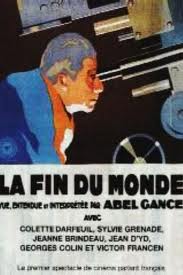
The first use of the ondes Martenot in cinema dates back to 1930, in Abel Gance’s film La fin du monde, in whose credits the name of Walter Ruttmann appears as artistic director. The original music, by Arthur Honegger, shows a desire to integrate new means of sound production through the use of “ondes musicales”.
The scenario of La fin du monde rests on a simple but effective plot, that of a scientist who discovers that the trajectory of a comet is going to cross the orbit of the Earth. The end of the world is near. The comet in the end merely grazes the planet. That said, before discovering its final trajectory, the population, believing itself lost, celebrates the last moments of life in a monumental orgy. Jean Laurendeau, biographer of Maurice Martenot, relates that in this sequence, “the filmmaker and brilliant innovator Abel Gance wished to use Maurice Martenot’s instrument for a panic scene in his film La fin du monde. The Martenot family sent him Olga Bilstin, daughter of Youri, entrusted by him to Madeleine (Martenot) during one of his trips to the United States. Olga was not an ondiste. But she would only be asked to simulate, with the ribbon playing technique specific to the instrument, the whistling of the wind. There was no need to have attended the conservatoire for that. On her return from the film studios, she recounted the following: 90 extras had been warned that they would be told what to do at the right moment; they knew nothing else. When that moment came, a veritable downpour accompanied by torrents of water was unleashed, with the complicity of the Paris fire brigade. This is where Olga came into play, giving sound to the wind and the terror. Abel Gance, for his part, was content to film the “spontaneous” general panic that resulted… – This last anecdote is among the recollections of Madeleine Martenot”. “For a reason that has never been explained, it is in the end Maurice Martenot who plays in the film. He is himself in the picture: he can be glimpsed briefly, handling his remote-control device, in the middle of an orgy scene, slightly anachronistic in such surroundings, thoroughly concentrated on his work, while the cataclysms planned by Abel Gance break out”.
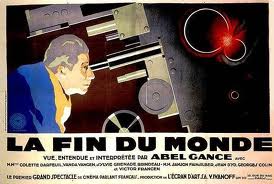
Despite the presence of Maurice Martenot and his instrument on screen, (3’07) this shot goes almost unnoticed when the film is screened. Only an attentive and forewarned viewing allows this unusual performance to be observed. In the first place, seeing a man stand at a distance from a piece of furniture, moving his arm back and forth in the void, is far from evoking the traditional gesture of a musician playing his instrument. Let us specify that the ondes Martenot used for the film in 1929 are in their second version, that is to say that the variations in pitch are made along a wire, guided by the movement of the performer’s fingers – the wire is invisible on screen.
It should also be noted, on two occasions, the technique of speeding up the sound in order to stylise the language of an African tribe panicking at the approach of the comet (1’10).