Rythmes
Robert Delaunay, 1934
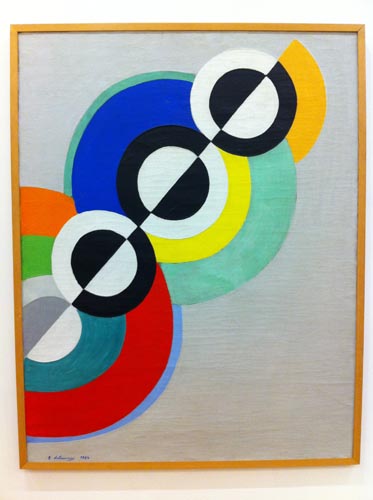
Rythmes, 1934,
Centre Georges Pomidou, Paris.
Rythmes is a representative painting from the long series of the same name, of paintings and reliefs created by Robert Delaunay between 1930 and 1938. It attests to the radicalisation of his research and to a return to circular forms. He adopts the principle of a composition split by a record line unrolled diagonally across the neutral ground, giving it its mobility and momentum. The choice of a central circular module, representative of the vinyl medium, rendered in black and white, reinforces the non-objective and optical character of the work, whose visual rhythm is created by relationships of colour.

Rythme, joie de vivre, 1930
Centre Georges Pomidou, Paris.
Delaunay would also apply the formula in vertical compositions, such as Rythme sans fin, 1934, in which the discs are drawn into a movement that raises towards the sky Brancusi’s “endless columns”. Delaunay then returns to the figure of the coloured disc, reinterpreting his approach to the “Orphic Cubism” of the 1910s. The meaning of the word “Orphism” clearly refers to Apollinaire’s poem Orphée (1908), which deals with pure poetry, as a kind of “luminous language”. Another interpretation of this term is proposed: the name makes an analogy between this painting and music; indeed, at the beginning of the 20th century, music represented modern art par excellence, perfectly abstract and therefore pure, and carrying a totalising function. It could unite all the arts, as in the operas of Richard Wagner through the concept of total art through the Gesamtkunstwerk)
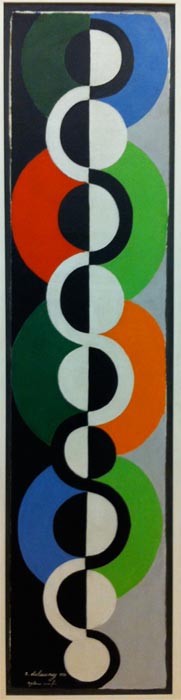
Rythme sans fin, Oil on canvas, 1934
Centre Georges Pompidou, Paris