Objets animés
Jacques Brissot, 1960
The text and video excerpt below document the book by Philippe Langlois, Les cloches d’Atlantis, musique électroacoustique et cinéma archéologie et histoire d’un art sonore, éditions mf, Paris, first quarter 2012.
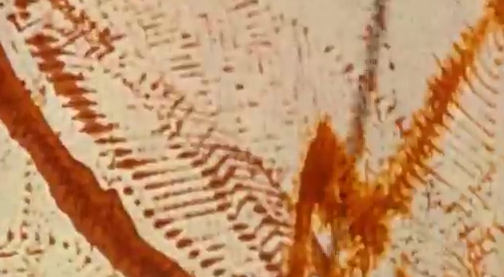
In this film Jacques Brissot establishes a parallel between the traces left by the various objects that the painter Arman moves across his canvases, and those of natural moving phenomena (waves, falling scrap iron) that were filmed. The film stands as an apology for movement, rendered here by short editing pushed to the extreme. Certain alternations occur at the rate of one frame per shot, that is 1/24th of a second.
Objets animés belongs to the series of films in which the image was edited to pre-existing music, and which at first inspired a “strong disapproval” from Pierre Schaeffer, since it used Schaeffer’s own Etude aux sons animés (made in particular from the sounds of a marble bouncing on a cymbal). Jacques Brissot had filmed “the manipulations of one of our painter comrades, Arman”, working “in dungarees”, and also making “necklaces of marbles and coil springs dripping with ink” roll across the paper. In short, Brissot uses the anecdotal effect of the origin of the sounds, and not “the internal logic of sound phenomena” on which Schaeffer the composer had worked. But if “everything fitted”, Schaeffer maintains, it is because “things, whether Image or Sound, speak the same language”.
This information notice was co-produced with INA/GRM for the creation of the multimedia fresco – Artsonores – L’aventure électroacoustique, in the category Films produced by the Service de la Recherche de l’ORTF from 1950 to 1975.