Ornament Sound
Oskar Fischinger, 1931
The text and video excerpt below document the book by Philippe Langlois, Les cloches d’Atlantis, musique électroacoustique et cinéma archéologie et histoire d’un art sonore, éditions mf, Paris, first quarter 2012.
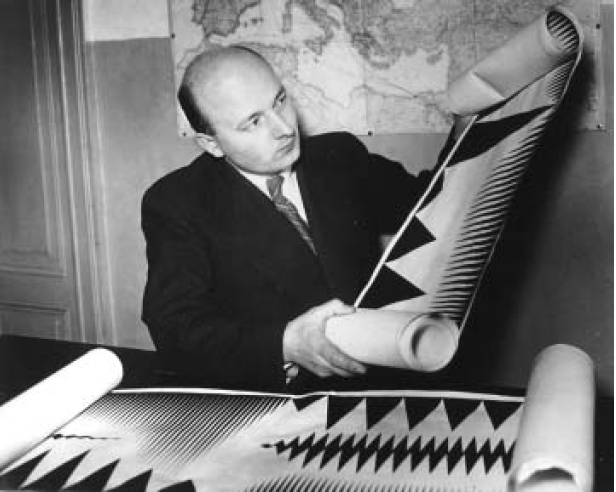
Like Rudolf Pfenninger, Oskar Fischinger can be considered one of the fathers of optical synthesis. A painter originally, he turned to cinema in the 1920s and produced a body of work centred on visual music,
His work on sound graphics culminated in an eight-minute film, Tönende Ornament – Ornament Sound – in 1932, in which he attempts to formalise scientifically the use of optical sound, thereby freeing himself from any pre-existing musical model. It is at this point that the great difference arises between Pfenninger’s approach and Fischinger’s, where the latter concentrates on the idea of modelling sound for synaesthetic purposes whereas Pfenninger works, for his part, at reproducing music to accompany the adventures of animated characters.
By declaring that he was making a music of light – Lichtmusik – in Ornement Sound, Oskar Fischinger manages to model a multitude of sound elements and parameters that he also calls stereoscopic sounds. To cover the range of possibilities offered by optical synthesis, Fischinger has to produce numerous conversion tables in order to determine the waveforms capable of producing distinct timbres, predetermined rhythms and controlled dynamics. He thus attempts to define scientifically the exact relationship that links the graphics on the optical track with the theoretical foundations of musical solfège.
See Philippe Langlois’s article on OSKAR FISCHINGER on the website Pionniers et précurseurs