Tönende Handschrift
Rudolf Pfenninger, 1931
The text and video excerpt below document the book by Philippe Langlois, Les cloches d’Atlantis, musique électroacoustique et cinéma archéologie et histoire d’un art sonore, éditions mf, Paris, first quarter 2012.
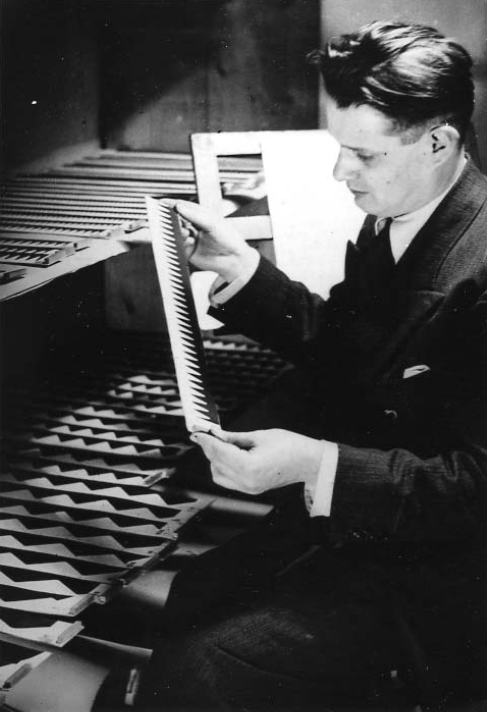
Tönende Handschrift can be considered a “manifesto film”. The title, “handwritten sound writing”, also introduces, through a play on words, the notion of a “sound manuscript”. This thirteen-minute short is a foundational film in the field of synthetic sound.
Made up of a first documentary part on the science of acoustics, Tönende Handschrift can be classed among the so-called “scientific” or “documentary” films, comprising in its first third a genuine didactic lesson in the physics of acoustics, enriched with a large number of synthetic sound examples. The commentary explains and illustrates in a simple manner the basic principles of acoustic physics: the speed of a wave in air and in water, the propagation of radio frequencies, the mechanism of recording and playback of the gramophone, sound frequency, waveform… The second part of the film takes place in Rudolf Pfenninger’s workshop and rests on an interview conducted by the journalist Helmuth Renar. Finally, the last part shows and lets us hear an application of the principles set out in the interview.
The film presented here, in German, is entirely unreleased