The Day the Earth Stood Still
Robert Wise, 1951
The text and video excerpt below document the book by Philippe Langlois, Les cloches d’Atlantis, musique électroacoustique et cinéma archéologie et histoire d’un art sonore, éditions mf, Paris, first quarter 2012.
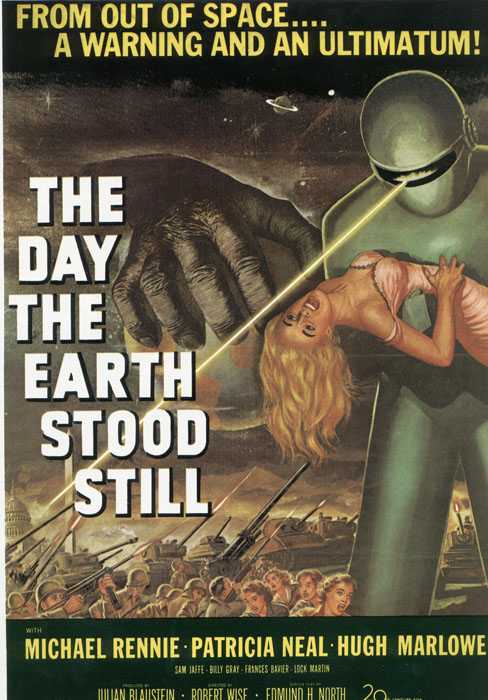
One of the finest musical integrations, blending traditional symphonic instruments with those of the new instrument-making, is no doubt found in Robert Wise’s cult film, The Day The Earth Stood Still, released in France under the title Le jour où la Terre s’arrêta. (1951). Indeed, no science-fiction film had ever deployed such instrumentation. The symphony orchestra that Bernard Herrmann conceived for this score offers sonorities and atmospheres that are utterly unheard-of in a film score, even in a score of any kind. Four pianos, four harps, some thirty brass instruments, a traditional string ensemble, a vibraphone and a pipe organ make up the basic instrumental line-up, one enhanced by instruments colouring the orchestra with entirely new timbres that suited the science-fiction character of the film: an electric violin and bass, instruments only just invented, and above all two theremins, a tenor and an alto, used as solo instruments.
The film’s first sequence, the flight over Washington, constitutes a genuine homage to Orson Welles’s The War of the Worlds, of which Robert Wise was the editor, notably through the radio announcement, in every language, of the saucer’s arrival, accompanied by an incomparable sound effect. This scene, followed by the landing of the flying saucer, reveals from the outset the full importance of sound in the film. A very rich sound texture, grainy and breathy at once, unfolds there, occupying the entire sound space on its own. Listening to it, this texture might be made up of a sort of tremolo of breathy sounds that are then transformed, and afterwards infested by a rough element that completes the noise of the craft.
The peaceful character of Klaatu the extraterrestrial has often been read as an allegory of the life of Jesus Christ, come to deliver his message of peace to mankind. Despite his pacifism, “the being from the sky” is hunted down and put to death. His resurrection takes place in the spaceship with the help of his robot and an imposing, sophisticated apparatus. The sound material invented to simulate the noise of the equipment is made up of concrete sounds (electrical crackling of every kind) and electronic sounds (a sustained high-pitched frequency and electronic pulses sweeping the sound spectrum at increasing speeds). This equipment slowly brings Klaatu back to life. After two chords typical of Bernard Herrmann’s universe – a descending minor second figure played by the brass pianissimo in tension / release – the music launches into an unusual trio comprising a solo electric violin and a duo of theremins, the latter fulfilling the harmonic function beneath the violin’s main melody, with its strange sonority.
Here is an article by Philippe Langlois published in 2005 in the journal Colonne sonore