Dr Jekyll and Mister Hyde
Rouben Mamoulian, 1931
The text and the video excerpt below document Philippe Langlois’s book, Les cloches d’Atlantis, musique électroacoustique et cinéma archéologie et histoire d’un art sonore, éditions mf, Paris, 2012.
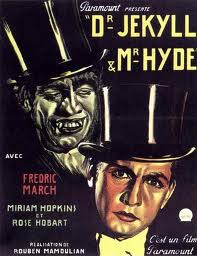
The idea of transformation and of the double dominates the mise en scène of this film, and this option, taken from the writing of the screenplay onwards, also guides all the work on sound, including the choice of music. From the opening credits, the question is one of transforming “sacred” music into “profane” music: Jean Sébastien Bach’s Toccata and Fugue in D minor, which we are used to hearing on the organ, is transcribed for symphonic ensemble.
By contrast, and to establish the link with this composition, the shot that opens the film is a vertical pan across organ pipes. The shot ends with hands playing on the keyboard. A Bach chorale rings out, this time with the sound of the sacred instrument. In subjective camera, on the organ’s music stand where the score rests, the shadow of Doctor Jekyll appears. We are here already in the presence of his double. The dialogue that follows with his valet reveals to us that Jekyll has to go out. He follows his valet, who gives him his coat – still in subjective camera, in Jekyll’s skin. We then discover his face for the first time : Fredric March, who plays the title role, stands before a mirror to adjust his clothes. Once again, it is a reflected image, a double. This opening, so carefully crafted in terms of visual and musical composition, is only the prelude to the revelation of the double.
The metamorphosis sequence naturally takes place in front of a mirror. To accompany it and endow it with total audiovisual coherence, Mamoulian wants to obtain an unheard-of sonority. By mixing the organic sound of heartbeats, to which he adds other sounds that parasitise the initial sonority, Mamoulian expresses the suffering of his character, who unwittingly abandons human appearance to give free rein to his bestial double. In other words, it is through the treatment of sound that the director represents the abandonment of sonic reality.
“To accompany the transformation, I wanted a completely unreal sound. At the start, I wanted a pulsation, like heartbeats. So we tried all kinds of percussion but they all sounded like percussion. Then I recorded my own heart, it was perfect, wonderful. We then recorded a gong, and removed the impact from it so as to be able to reverse the resonance. Finally, we painted directly on the optical track and I believe it was the first time anyone had used synthetic sound in this way, working from the light of the sound”.