Zero for Conduct
Jean Vigo, 1933
The text and the video excerpt below document Philippe Langlois’s book, Les cloches d’Atlantis, musique électroacoustique et cinéma archéologie et histoire d’un art sonore, éditions mf, Paris, 2012.
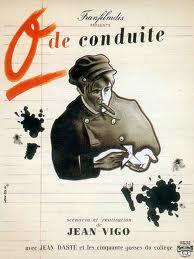
In this autobiographical film, Jean Vigo depicts the hardships, joys and dreams of life at boarding school. He rebels against the authority of teachers and against paedophilia, mocks the representatives of the state, and goes so far as to fly the black flag over the roofs of a public institution. Moreover, the proclamation of revolt and the provocations of the film ultimately mobilise the members of the censorship commission, who ban the film. This censorship would last until 1945. This ban was obviously linked to the revolutionary ideas contained in the script, but, more insidiously, it punished the family tie that bound Vigo to his father Miguel Almereyda, a notorious anarchist imprisoned in 1917 and found dead by suicide in his cell.
Zero for Conduct is a fiction film by Jean Vigo that traces life in boys’ boarding schools at the dawn of the 1930s. The return to boarding school is made by train, which becomes the pretext for the film’s opening scene. The sequence is entirely guided by the soundtrack, which is at once film score and sound effects for the incidents unfolding on screen.
Three years after Claude Roland-Manuel for La petite Lise by Jean Grémillon, Maurice Jaubert appropriates the retrograde score technique to compose the score of Jean Vigo’s Zero for Conduct (1933)
The second part of Zero for Conduct is signalled, just after the big train journey scene, by the following intertitle: the plot. In this sequence, the first signs of rebellion are put in place, and during the card that introduces the scene, Jean Vigo and Maurice Jaubert let us hear for a few seconds children’s cries played backwards. In our view, these brief sound accents are enough to announce the insurrection to come. Sound then takes on a premonitory function that anticipates the musical treatment of the dormitory scene.
The instructions Jean Vigo gives Jaubert to illustrate this sequence are to seek “a particular sound, as if sucked in” to convey the children’s dream world. To anchor the scene definitively in reverie, Jean Vigo films it in slow motion, a visual metaphor that reinforces on screen the particular treatment of sound that wraps the dream in a muffled texture.
The music creates a sound universe that materialises the world of dreams. The use of retrogradation allows this musical disembodiment, just like the camera that shoots the scene in slow motion. It is, moreover, necessary to shoot the sequence at high speed during filming in order to obtain visual slow motion at projection. Here, the interweaving of inversions and reversals between sound and image is organised subtly, revealing a rare audiovisual complementarity. Barely a few years after the appearance of sound in cinema, the degree of audiovisual integration at work in Zero for Conduct is quite remarkable. Far from any purely formalist effect, the work on sound in Jean Vigo’s first film demonstrates an extraordinary mastery that serves the great poetic value of his films.