Remorques
Jean Grémillon, 1942
The text and the video excerpt below document Philippe Langlois’s book, Les cloches d’Atlantis, Musique électroacoustique et cinéma, Archéologie et histoire d’un art sonore, éditions mf, Paris, 2012.
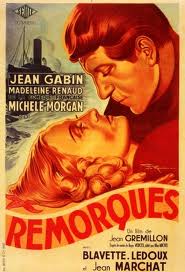
The soundtrack of Remorques is remarkable in several respects in terms of the integration of the different sound parameters: music, noises and speech, as in the storm scene at the beginning of the film.
“The rhythm is given by the soundtrack, which combines the breath of the storm and an orchestral ‘off’ music (…) then the music disappears to make way for the noises of the boat, followed by thirty-two increasingly short shots of pistons rising and falling, over a very rhythmic crescendo of noises that illustrate the acceleration of the tug’s pace (…) The passage from one image to another obeys the rhythm of the music, which gives the impression of a perfect harmony between the mechanical world and the human world”.
The most accomplished example of this fusion of sound elements is very probably found in the final scene of Remorques, where four elements are mixed: the litany of the song of the departed, in spoken chorus, the music of Claude Roland-Manuel (based on the vocal scansion), the howling of the storm wind and, to conclude the film, the voice of Jean Gabin announcing the tug’s departure (synchronised with the last line of the chorus on the word “solitude”).