Égypte ô Égypte
Jacques Brissot, 1958
The text and the video excerpt below document Philippe Langlois’s book, Les cloches d’Atlantis, Musique électroacoustique et cinéma, Archéologie et histoire d’un art sonore, éditions mf, Paris, 2012.
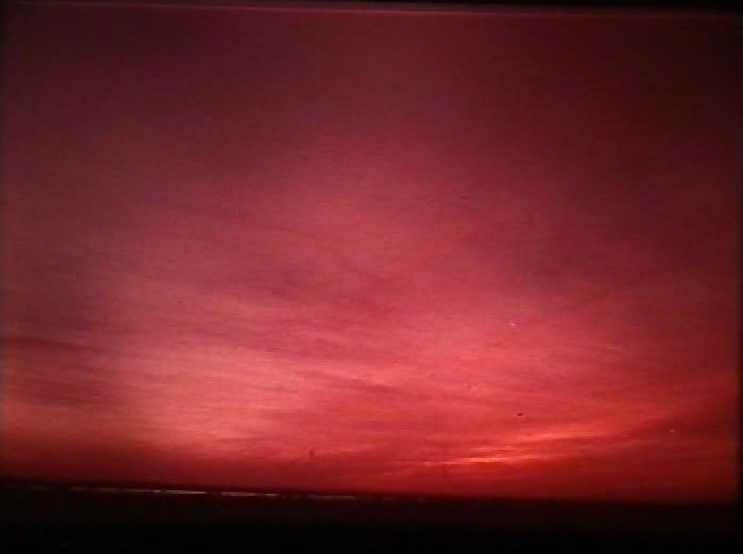
The third and last part of this documentary trilogy on Egypt, and the title that gives its name to the whole, Egypte Ô Egypte presents itself as an essay on funerary texts drawn from the Livre des morts des anciens Egyptiens by Grégoire Kolpatchy. Without doing the work of an Egyptologist, but attracted by Egyptian cosmogony, Jacques Brissot strove to give a cinematic equivalent of the soul’s long journey through the land of the dead, with its portals that are so many initiatory stages. The camera wanders through the landscapes and temples of the Valley of Thebes, among pyramids, gigantic statues, vistas of colonnades, frescoes and hieroglyphs. Direct shots alternate with frame-by-frame filming, which makes perceptible, in fast motion, the progress of shadows across the stones. The shots follow one another according to plastic and geometric relationships that attempt to recover the deep meaning of Egyptian symbolism.
The soundtrack of the third film consists solely of the text spoken by Roger Blin and of Ferrari’s music, in a skilfully composed interweaving. For the first time in Luc Ferrari’s work, the music mixes instrumental sounds (a small orchestra of seventeen musicians) and concrete sounds, interlocked in a structure that also mixes ambiguous sounds on the threshold of the two universes, the fruits of manipulations of both.
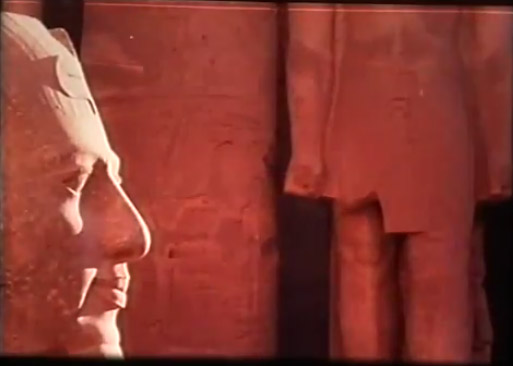
Like Jacques Brissot’s images, the music of Egypte Ô Egypte is contemplative; it thus directs the listener towards a very meditative listening and carries the listener into a universe of extreme slowness. Sound events are indeed very distant from one another, linked by drawn-out resonances, as if to recall that distant era when the temples were built, and the time that links them to our own contemplation, as if to “capture the resonance of ancient times”. The slowness of the sound is matched, by contrast, by the rapidity of the images illustrating the symbolism of the god Amon Râ in ancient Egypt, achieved thanks to an original filming process. Thus, the image of a temple filmed every minute throughout an entire day reveals in projection the daily course of the sun, in fast motion, gliding over elements of pharaonic architecture.
With such a process, the visual rendering makes it possible to see the sky, the clouds and the shadows file past and set themselves in motion along the façades until they seem to crawl over the stone. Taken from different angles, “the slightest crack, roughness, the smallest angle come alive in these ‘things’ that have remained motionless for four thousand years and are suddenly animated by the sound of these stretched textures”.
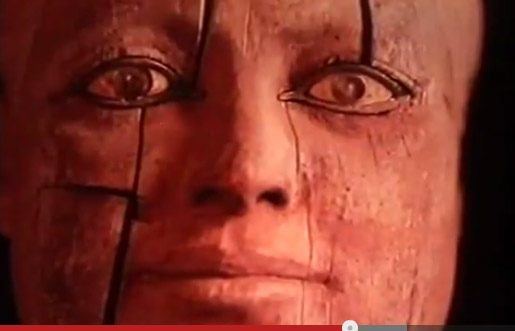
On the sound level, the movements of nuance, of differentiation of pitch, of the pace of the sound, are so many sound components that imposed themselves on Luc Ferrari through the treatment of the image. Beyond the purely mechanical aspect, this crossing of technical approaches results in work on visual and sonic matter that traverses time, to the point of revealing its “ardent” aspect. By playing in this way on resonance and temporal inflection, a link with the mythology of the Book of the Dead is created almost automatically, making this film one of the great successes, still little known today, that leads to the creation of the Service de la Recherche.
Luc Ferrari’s wholly experimental and intuitive approach, linked to Jacques Brissot’s visual approach, made it possible to create a film of powerful beauty, rewarded with the prize of the Biennale de Paris in 1963.
An excerpt.