Trois portraits d’un oiseau qui n’existe pas
Robert Lapoujade, 1965
The text and video excerpt below document the book by Philippe Langlois, Les cloches d’Atlantis, Musique électroacoustique et cinéma, Archéologie et histoire d’un art sonore, éditions mf, Paris, 2012.
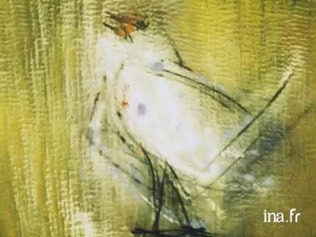
Starting from a poem by Claude Aveline, “Portrait de l’oiseau qui n’existe pas”, Robert Laoupjade makes this short animated film, “Trois portraits d’un oiseau qui n’existe pas” (bird of prey, hummingbird, songbird). A painter and filmmaker, he achieves in this film a synthesis of these two means of expression by setting in motion, thanks to the animation technique of powders and various materials, a painting in perpetual change.
For this film produced by Roger Leenhardt, the musical collaboration of a renowned composer such as Georges Auric or Henry Sauguet was envisaged. According to François Bayle, the production was looking for an illustrious signature to complete an already prestigious cast. Yet, after numerous delays in the delivery of the images, Georges Auric and then Henry Sauguet withdrew, and the presentation of the film, as part of a festival taking place very soon, prompted the Service to appoint François Bayle as a last resort. He was asked to compose a “temporary” music, a few days before the film’s presentation.
François Bayle’s music, based on the idea of sonic mutation, gives at once an equivalent and a parallel to the plastic beauty of Robert Lapoujade’s half-figurative, half-abstract images. The score comprises a horn, a harpsichord, an oboe, as well as concrete sounds.
The general form of the music is disparate, without any real continuum; the sounds obtained with this heterogeneous ensemble, made up of scattered noises and surreal croaking, give us to hear an imaginary sound world that fits the images of Lapoujade by aleatory synchronism. Modestly, François Bayle claims to have “in a few days, knocked out an unexpected and jaunty music that suited Lapoujade’s images very well”.
Naturally anxious, like most film people faced with their silent images, Robert Lapoujade is finally satisfied with François Bayle’s music. Well defended by the director, the film’s music was finally adopted without any other composer being called upon for a definitive version.
This information notice was co-produced with INA/GRM for the creation of the multimedia fresco – Artsonores – L’aventure électroacoustique, in the category Films produced by the Service de la Recherche de l’ORTF from 1950 to 1975.