Un garçon plein d’avenir
Peter Foldès, 1965
The text and video excerpt below document the book by Philippe Langlois, Les cloches d’Atlantis, Musique électroacoustique et cinéma, Archéologie et histoire d’un art sonore, éditions mf, Paris, 2012.
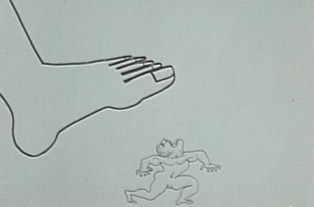
An animated film conceived and directed by Peter Foldès on a dark scenario that can be seen as a metaphor for human cruelty, through the growth of a man from his birth, when, already as a baby suckled by his mother, he ends up devouring her. Having become an adult, he experiences his strength and war, and gives himself over to the destruction of everything within his reach. It is Schubert’s romantic music that seems to restore a human face to this ultra-violent character and allow him to feel the sentiments of remorse and then love. This lull is however only short-lived, and his murderous impulses quickly regain the upper hand because of the provocations of an immodest woman. Resuming his devastating march, he ends up perishing, crushed by a force even greater than himself.
Although it belongs to the register of the cartoon, the film is nonetheless not intended for a young audience.
The approach of Luc Périni’s audio track is conceived as a veritable programme music oscillating between a soundtrack that is at once stylised and illustrative, representing the adventures of this monstrous character by resorting, notably, to a whole sound imagery taken directly from referential registers (boxing, cries, crowd, war noises, an excerpt from the first movement of Franz Schubert’s Symphony No. 8).
The music during the opening credits takes up martial rhythms played on a barely distorted snare drum, as well as strident and evolving textures of musique concrète that seem to represent the danger and growing cruelty of this bloodthirsty monster
This information notice was co-produced with INA/GRM for the creation of the multimedia fresco – Artsonores – L’aventure électroacoustique, in the category Films produced by the Service de la Recherche de l’ORTF from 1950 to 1975.