Étude 65
Piotr Kamler, 1965
The text and video excerpt below document the book by Philippe Langlois, Les cloches d’Atlantis, Musique électroacoustique et cinéma, Archéologie et histoire d’un art sonore, éditions mf, Paris, 2012.
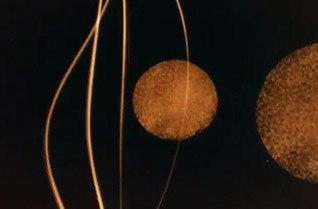
As its title indicates, this film is a study that takes up an older cinematic essay entitled Continu discontinu (1960), an experimental film constructed as an intersidereal journey at the speed of light that introduces us to an unknown planetary world, a pretext for an exploration of matter of the kind Piotr Kamler is fond of. Against a black background, circular forms detach themselves, draw closer, move away like so many brightly coloured organisms. The matter is dense and almost palpable, contrasting with tapering lines that heighten the dynamism of the movements inside the screen. This small abstract film in mineral colours is an application of the powder technique to the animation process. An optical process that brings the material used into the light. The film is inhabited by a music that becomes so intense that it ends up disappearing, leaving this unfinished essay in the silence of a soundtrack that ends up disappearing.
Etude 65 presents itself as a new proposal for sound-setting based on the pre-existing film by Piot Kamler Continu discontinu (1961), originally divided into two parts composed respectively by Luc Ferrari and Iannis Xenakis. This new audiovisual proposal for the second part thus benefits from a musique concrète by Beatriz Ferreyra, which makes it a singular audiovisual experiment and one of the rare films to possess several original scores.
Conceived above all as a pure audiovisual experiment, the end of the film is not completed.
This information notice was co-produced with INA/GRM for the creation of the multimedia fresco – Artsonores – L’aventure électroacoustique, in the category Films produced by the Service de la Recherche de l’ORTF from 1950 to 1975.