Scanner
Céleste Boursier-Mougenot, 2006
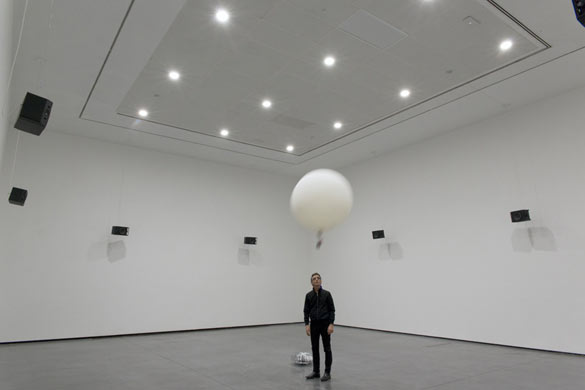
In 2015, for the first time, a sound artist will represent France at the Venice Biennale. That said, even before making a name for himself among sound-based visual artists, Céleste Bousier-Mougenot had first distinguished himself, from 1984 to 1995, as a musician and composer for the company of the author and director Pascal Rambert, Side One Posthume Théâtre.
His approach is that of an artist fully embracing his musical origins, who has for twenty years been extending a reflection on generative music, which he himself describes as “living”, through devices and situations capable of producing perpetually evolving music, by way of sound installations that most often proceed from the diversion of everyday objects.
Like Steve Reich’s Pendulum Music (1968), in which microphones swinging above loudspeakers generate periodic feedback, he too puts to use this effect, also called “Larsen”, which musicians ordinarily try to avoid, in a prototype version of his installation Scanner presented in 2006 at the FRAC Champagne-Ardenne, in Reims.
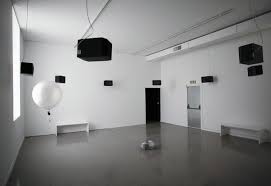
Propelled by a fan placed directly on the floor, a helium balloon fitted with a wireless microphone explores the space of the exhibition venue, constantly modulating the feedback produced by eight loudspeakers distributed on the walls all around. From the variation of the feedback, modulated by the movement of the balloon, there results a music of space, indeterminate, in perpetual recomposition, a music of the moment that can be placed in the lineage of the works of John Cage and Alvin Lucier initiated in the 1960s. Moreover, the sound of the feedback is itself analysed in real time, synthesised and rebroadcast live by an audio processor that continually varies its pitch and its timbre according to its amplitude (volume). To the permanence of the fan’s sound are added the fragile appearances of the modulation of the feedback which appear and travel back and forth across the exhibition space.
This same search for an instantaneous, living, spatial music is found, for example, in many of his installations featuring birds, which he devised between 1995 and 2007 in the different versions of From Here to Ear, or again in Relais (2012) for beehive and microphone, Index (2009), which translates into notes on a MIDI (Musical Instrument Digital Interface) piano the typing of words in a word-processing programme, Variation (2009), taking up the principle of Scanner, this time no longer in the air but in water, where amplified ceramic elements floating in pools knock against one another and are then rebroadcast in the exhibition space, or, finally, Harmonichaos for vacuum cleaners and harmonicas, and so on.
Prototype, mixed media, floor dimensions 8 x 8 m, 2006
Latex balloon inflated with helium,
wireless microphone, multichannel audio processing
and diffusion system, fan.