Pendulum Music
Steve Reich, 1968

Pendulum Music is a piece conceived for 2, 3, 4 or X microphones, amplifiers, loudspeakers and performers.
In the mid-1960s, in New York, the work of conceptual artists such as Sol Lewitt, Richard Serra, Bruce Nauman and Michael Snow was more or less associated with the minimal art current. Steve Reich represents, in a way, the musical figure within this movement. He was then experimenting with the arrangement of electroacoustic sound devices. Halfway between sound installation and musical piece, Pendulum Music thus continues Reich’s work on the phase-shifting of magnetic tape loops on tape recorders, as, for example, in Come Out (1966) or It’s Gonna Rain (1967)
Pendulum Music was first presented in 1969, during a summer session at the University of Colorado, integrated into a multimedia show entitled Over evident Falls in collaboration with the painter Bill Wiley. The event is described by Steve Reich as “a hastily conceived Happening” in a staging in which the spectators attended the event amid a shower of fake snowflakes lit by black-light neon tubes.
A photo of the performance of 2 May 1969 at the Whitney Museum of American Art in New York shows the artists Richard Serra, James Tenney, Bruce Nauman and Michael Snow ready to give the first impulse to the swinging of the microphones.
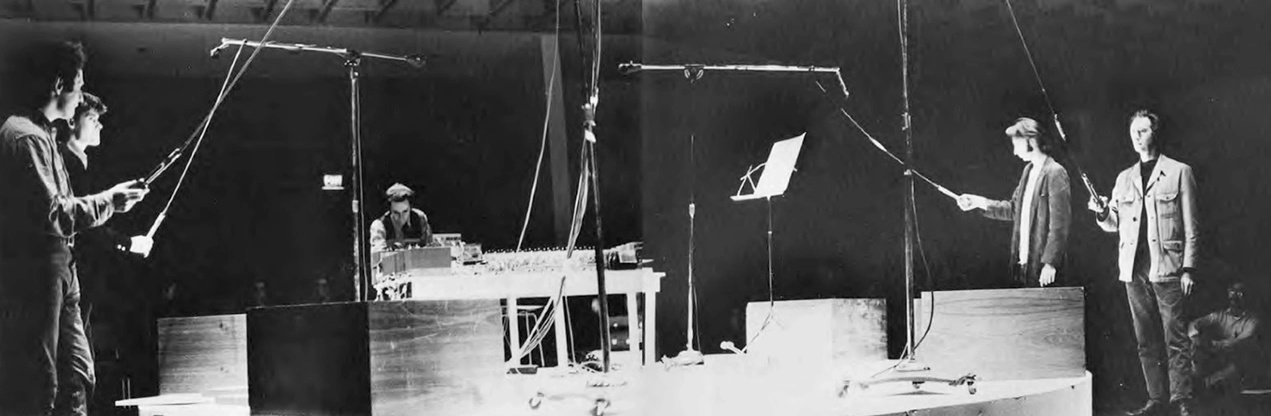
The sonic principle of the piece is simple and rests on the swinging motion given to microphones suspended above loudspeakers, producing a periodic feedback effect.
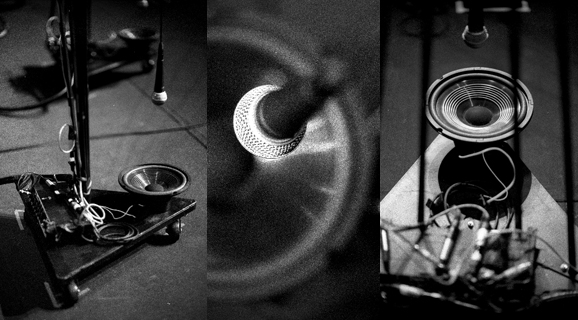
In a slow process of deceleration, the amplitude of the swinging diminishes and phase-shifting effects occur between the different microphones. The form of the piece then merges into the slow process that depends on how long the microphones swing, until they settle above the loudspeakers, creating continuous feedback effects. The periodicity and rhythm of the beginning of the piece are gradually replaced by modulating frequencies that shift listening away from rhythm and onto the parameter of pitch.
Listening also turns to the acoustic phenomenon and to the ever more minute variations in the structure of the feedback as the microphones oscillate slowly, close to coming to a halt. Pendulum Music also fits fully within the idea of a poly-sensory work that is as much to be seen as to be heard, allowing the eye to perceive the micro-modulations of the sonic material through the swinging movement of the microphones.

The “score” of the work, which is in reality a simple handwritten text by Reich, was written in August 1968 and revised in May 1973 by the composer. It indicates that the performers, after giving the first impulse to the swinging of the microphones, must join the audience to watch it unfold.
Here are two versions of the piece.
Reconstitution of Steve Reich’s legendary piece at the école des beaux Arts du Mans, on 21 November 2014, as part of my course: Histoire et théorie du sonore..
Performers: Pierre-Marie Blind, Léo Urriolabeitia, Koré Préaud, Tanguy Clerc, Arthur Chambry, Rémy Hertrich.