Imaginary Landscape No. 4
John Cage, 1951
Imaginary Landscape n°4 is dedicated to Morton Feldman. Twenty-four operators are needed to perform this work, that is two per radio set: the first to vary the frequencies, the second to control the volume.
It seems futile, even contradictory, here, to try to account for the scope of this work through the immutable instants of the video recording, which freezes the performance of a score that, intrinsically, seeks permanent renewal and indeterminacy in each of its interpretations. Are not the recordings that illustrate this discussion, then, counter-examples of what Cage sought precisely to approach: indeterminacy in the instant of each of its performances?
The percussionist Lê Quan Ninh, a specialist in the performance of the music of John Cage, indicates that this work must not be performed frontally but that the radio sets must on the contrary be dispersed in space. Nor should the piece be conducted by a conductor. Thus the two examples that follow seem very far from an ideal performance.
Excerpt from an article by Catherine De Poortere,
The radio set, from which John Cage extracts random sound as he might from any found object, stands at the centre of two performances (1951 and 1956) of an almost contemplative, disinterested sobriety. Dizzying in effect, these stagings nonetheless remain simple and ordinary. In the midst of the century of the avant-gardes, John Cage is not among those who, without discernment, exalt progress and seek to take advantage of it. In art as in society, in facts as in life, technical innovation, whether literal, playful or even subversive, stands in for neither style nor content. In the eyes of this multidisciplinary yet radical artist, there is no art but living art, emancipating, always becoming. The work cannot present itself as a fixed form, an inert, sclerotic form; that is perhaps the corpse of art – if indeed art does not necessarily abolish its own end.
This is how Cage proceeds: framing in order to free. Lovers of original notations will be delighted by examining the “scores” of “Radio music” and “Imaginary landscape n°4”, in which the artist details frequency intervals, silences and other Hertzian specificities, first on a stave and then directly in numbers and strokes, so as to open the field of manoeuvre as wide as possible. These two pieces, which each employ some ten radio sets and twice that number of performers, are destined to be unique (we leave aside “historic” recordings, a contradiction in terms), all the more so as radio is constantly evolving, in form and in content. If radio is hardly more than one sound object among others for John Cage, even more than the prepared piano, it is the instrument of indeterminacy par excellence. Its multiplicity reflects the multiplicity of all, reflects still more the multiplicity of one alone – and at times it even seems to bear the gravity of its destiny. Unanimous and resembling, is it the expression of all or of one alone? Or, ungrateful immanence, does it reveal only a gathered, deformed face – its arbitrary face?
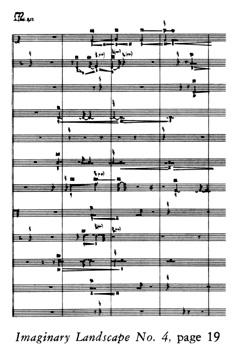
Radio has no meaning, it contains them all, retains none. The breadth of an imaginary landscape is limitless. Listening, one finds oneself at once transported as on a long car journey. There always comes a moment when, in the torpor of monotony, one absent-mindedly switches on the radio. Groping (what are we looking for? what are we waiting for?), one abandons oneself to the indistinct waves, it can last tens of minutes, between two towns on the motorway there is not much, one passes too quickly from one station to another, everything is fluid, the static glues together scraps of voices, unknown languages, musical notes, cries, laughter… Radio is this acousmatic medium that removes certain forms of silence, solitude and emptiness only to replace them with others, more insidious, more formidable, because more commonplace… This is what these two pieces by Cage evoke, these times of drift, these abstract, infinitely hollow times in which, without admitting it, what we listen to on the radio is radio itself, an incoherent totality, continuous and discontinuous, mournfully reassuring, a lullaby suited to half-sleep, to the mad reverie of pure passivity.