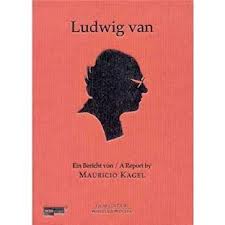
Ludwig van
Mauricio Kagel, 1970
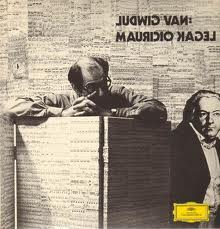
For the bicentenary of Beethoven’s birth in 1970, Mauricio Kagel undertook the making of “Ludwig van”, the first of his films, conceived as a genuine interrogation of the use of Beethoven’s music.
This black-and-white film is deliberately off-kilter, unsettling, irreverent, even provocative.
The traditional codes of narrative are transgressed in the linear sense of the term through a film made up of scenes with no connection between them apart from the legendary figure of the great Romantic composer.
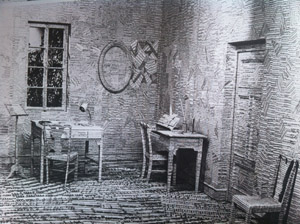
We thus visit places where Beethoven lived: his study, a room entirely covered in musical notes; his cellar, a lumber room filled with wine bottles; his attic, where scores by nineteenth- and twentieth-century composers are piled up; his bathroom, in which the bath is full of busts of… Beethoven, which are removed one after another.
Neither documentary report nor biographical film, Kagel uses and abuses anecdote to divert the codes of the film “in homage to” and to attempt to build a portrait in negative, provocative, taking us by surprise, even irritating in a hilarious way.
In no particular order, he shows a ridiculous televised debate on Beethoven and his music; an assessment of the physical, moral and psychic capacities of Beethoven’s music on performers (this part is one of the funniest); an interview, in a field, with a descendant of Beethoven…
The film ends at the zoo, with scenes presenting animals in attitudes as eloquent as possible, even scatological, in particular the sequence in which, under the baton of Herbert von Karajan, Beethoven’s music is accompanied visually by the defecation of a large pachyderm, which can be interpreted as a metaphor, at once comic and insulting, referring to Karajan’s somewhat “bombastic” conducting style.
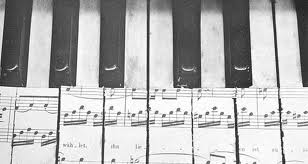
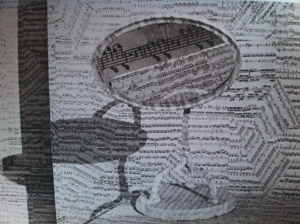
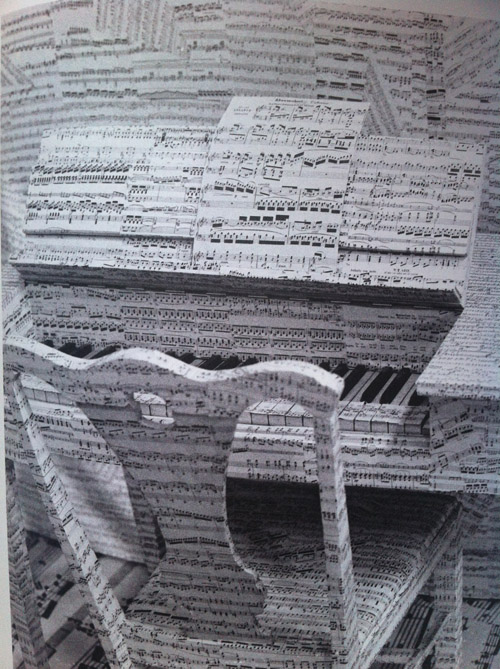
The episode of the room is a genuine visual-art installation in the sense that Kagel covered every surface of the study with his scores. Not a single patch is spared: mirrors, worktable, chair, piano, floor, door, and so on. The music of this sequence is an “on-the-fly” interpretation of the pieces of score of a quartet that can only play the parts picked up by the camera. In this sense this part forms a genuine generalised collage, visual and musical, which lets us hear Beethoven’s deconstructed music as a kind of illusion and reminiscence of the composer’s entire œuvre.
The excerpt that follows offers an immersion in Beethoven’s study covered with all his scores.
The film is available in a box set “The Mauricio Kagel Edition” (2 CD + DVD)