Caustiques
Gérard Patris, 1959
The text and video excerpt below document the book by Philippe Langlois, Les cloches d’Atlantis, musique électroacoustique et cinéma archéologie et histoire d’un art sonore, éditions mf, Paris, first quarter 2012.
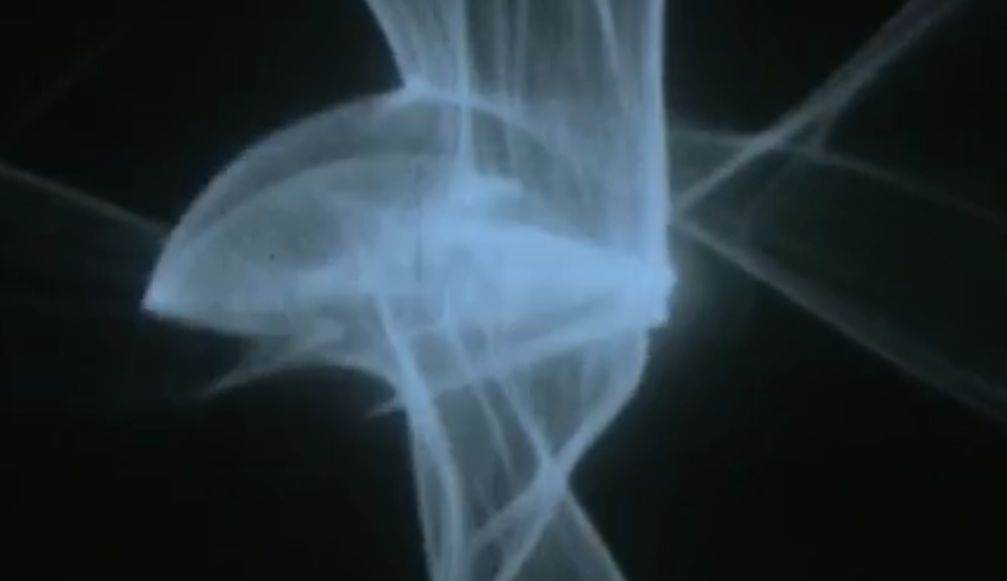
In optics, the term caustic designates the envelope of light rays undergoing reflection or refraction on a curved, shiny surface. In this film, Gérard PATRIS and Jacques BRISSOT did not seek to capture the scientific process by which a caustic forms, but preferred to use the fabulous luminous images that result from the properties of reflected light, in order to fix through the camera the magic of their movement and their slow beauty.
Among the productions of the Service de la Recherche, this film belongs to one of the fundamental lines of research initiated with the aim of establishing a form of language between sound objects and visual objects.
The experience of the film extends as far as the fusion of images and music, creating a genuine audiovisual alchemy, a kind of “cinematic caustics” in which, in a delicate, floating ballet, the reflection of sound tends to be echoed in the image and, conversely, the refraction of the image melts into the sound.
Although they come from differentiated audiovisual sources – the image does not come from the sound and, conversely, the sound does not come from the image – the audiovisual relation is established at the level of audiovisual movement on the screen, in the morphology of the visual and sonic objects, the speed of their movement, the juxtaposition of images and sounds by mixing and superimposition, a poetic encounter of image and sound, in the wake of works of synaesthetic scope that oscillate between interlacing and avoidance.In Le contrepoint du son et de l’image, Pierre SCHAEFFER described this film as a “characteristic example” of the group, marked by “analogy”: one films the reflecting surfaces of metallised plates accompanied by music using their sonorities “just as the dance-hall band suits Westerns and soft music suits love”.
Production date: Service de la recherche de l’ORTF, 1959
music by François Bernard Mâche.
This information notice was co-produced with INA/GRM for the creation of the multimedia fresco – Artsonores – L’aventure électroacoustique, in the category Films produced by the Service de la Recherche de l’ORTF from 1950 to 1975.