Box with the Sound of Its Own Making
Robert Morris, 1961
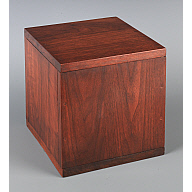
Wood (24.8 x 24.8 x 24.8cm), loudspeaker, duration 3h1/2.
Born in 1931, Robert Morris is considered, together with Donald Judd, one of the main theorists of Minimalism. Close to the composers La Monte Young and John Cage, his piece Box with the Sound of its Own Making is at once a homage to Marcel Duchamp’s Ready Made and a contribution to developing the idea of a Minimalist sculpture in the wake of Process Art, rejecting any Romantic approach to the process of artistic creation.
Robert Morris made this work in January 1961 in New York. The box is made up of six pieces of wood joined together to form a perfect cube 28 cm on each side.
During the three and a half hours that the construction of the box lasted, Robert Morris made an audio recording that captured all the noises of the construction: sawing, hammering, sanding, the artist’s movements about his studio, and so on.
In its principle of display, the box thus lets the spectator hear the sounds of its making, thanks to a small loudspeaker placed inside the box which allows the creation of the work to be reactivated in real time.
In Morris’s artistic circle, the box is also perceived as a form of musical performance. John Cage, visiting Morris’s studio, considered the work a private concert, settling in front of it to listen to the entire recording.
Escaping any idea of artistic classification, Box with the Sound of its Own Making brings to light the relationships that can unite sculpture and music, visual and acoustic perception, object and creative process.
The recording below is a simulation, a reconstruction made by Kate Blacker.