Silent Echoes - Le Mans
Bill Fontana, 2026
Sound no longer meant for the ear,
Deeper ear that listens to us
False listeners. Conversion of space.
Projection outward of inner worlds…
Gong, Rainer Maria Rilke (1925)
Translated from the French version by Philippe Jaccottet.
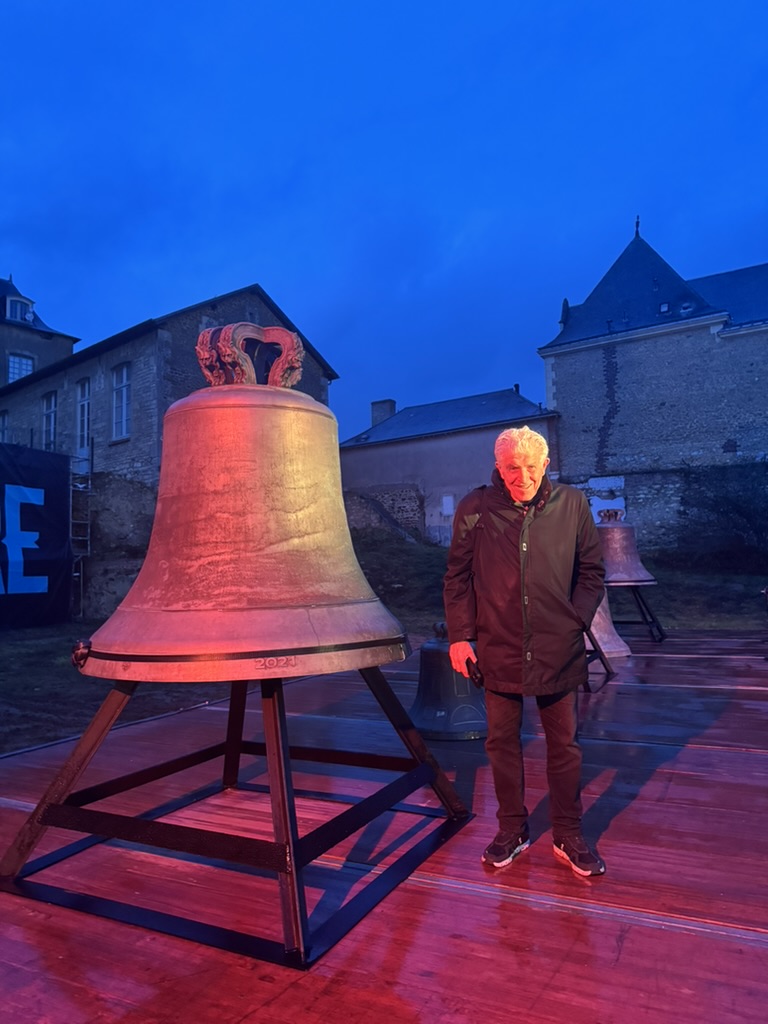
The sound installation Silent Echoes Le Mans
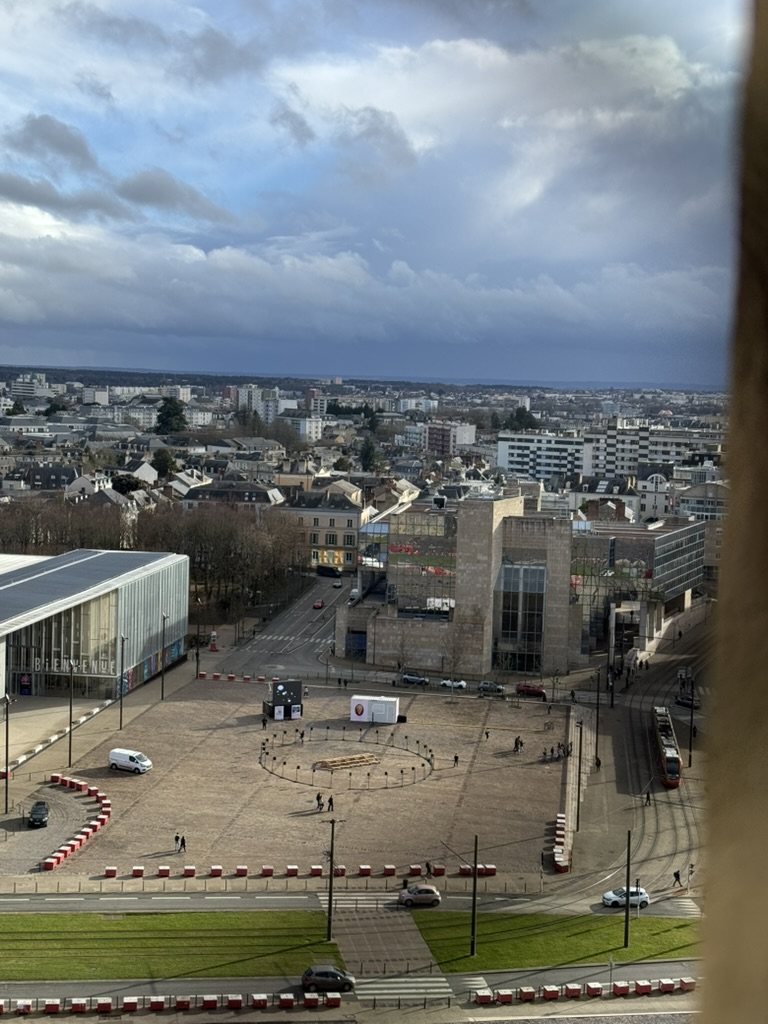
Californian artist Bill Fontana, patron of this fourth edition of the biennial, continues his work on silent resonances with his new sound sculpture Silent Echoes Le Mans, installed on the Esplanade des Jacobins. In this new work, he draws on the resonance of five of the six bells of the Royal Abbey of Fontevraud, specially transported for the occasion and displayed across the great Place des Jacobins, in the gardens of Saint-Julien Cathedral.
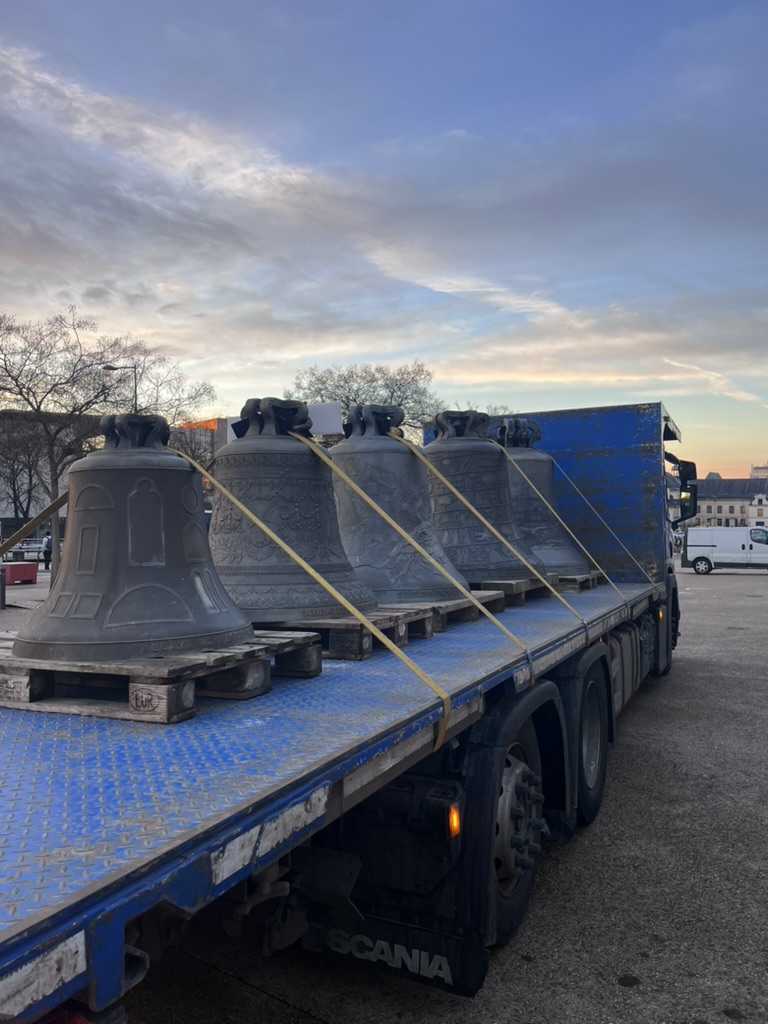
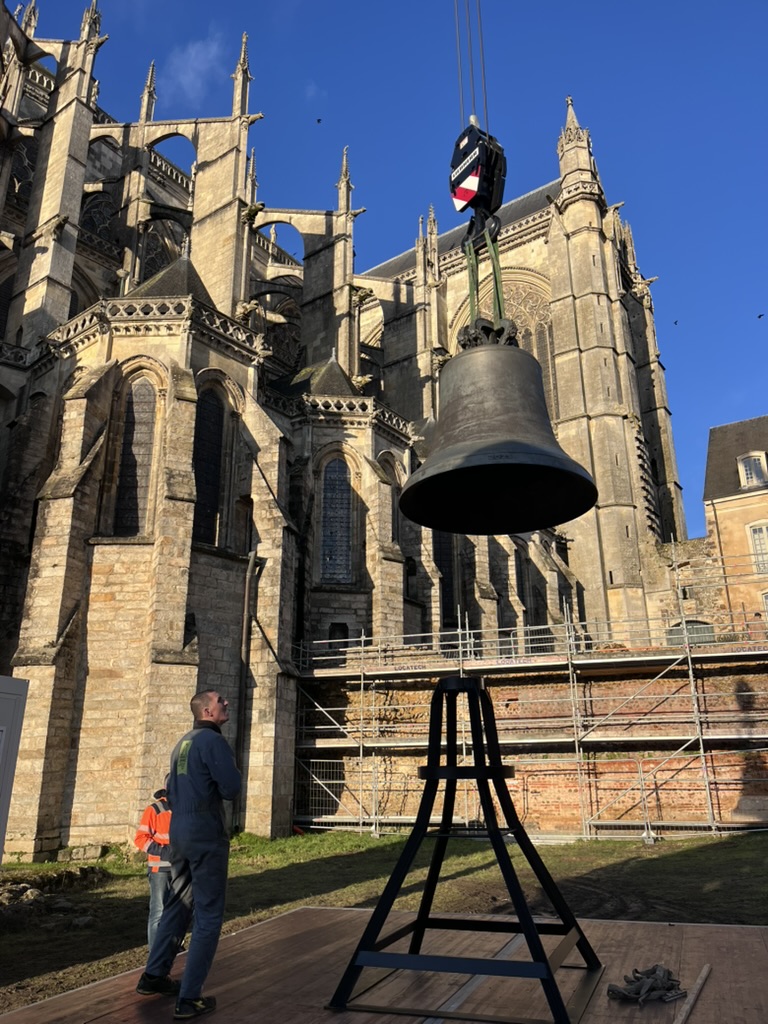
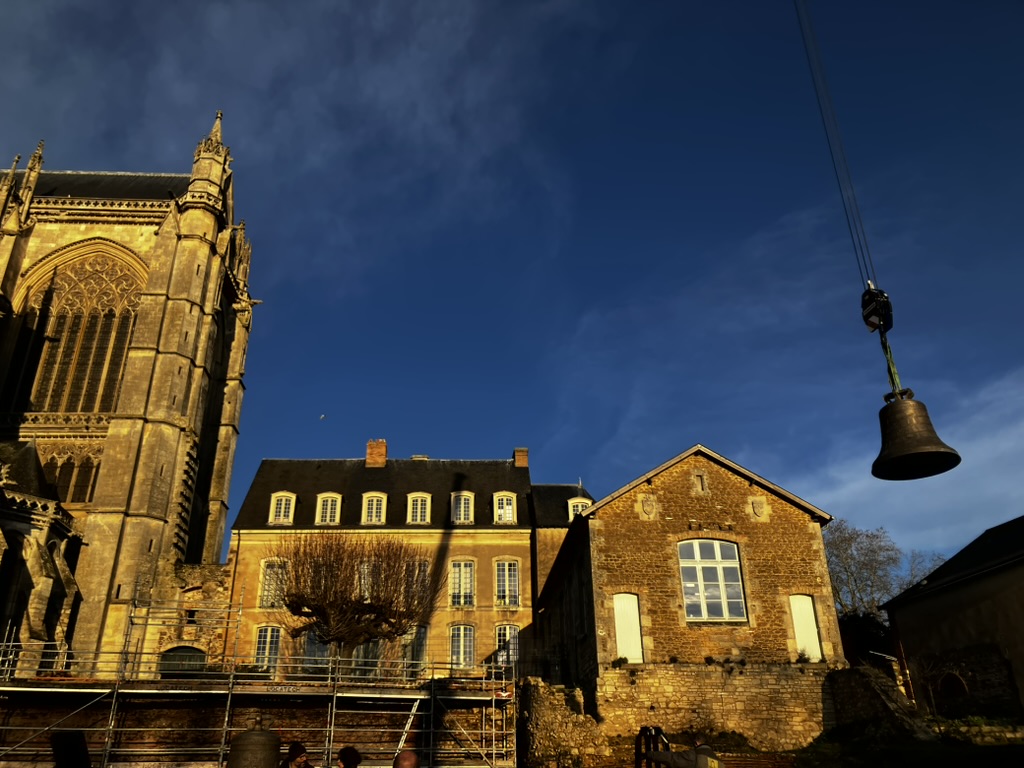
These bells are silent, and yet, even when they are not ringing, they are constantly vibrating. Paradoxically, this surprising situation – the absence of ringing, the bells’ silence – makes it possible to use a basic acoustic phenomenon shared by all vibrating bodies: their vibration always generates sound.
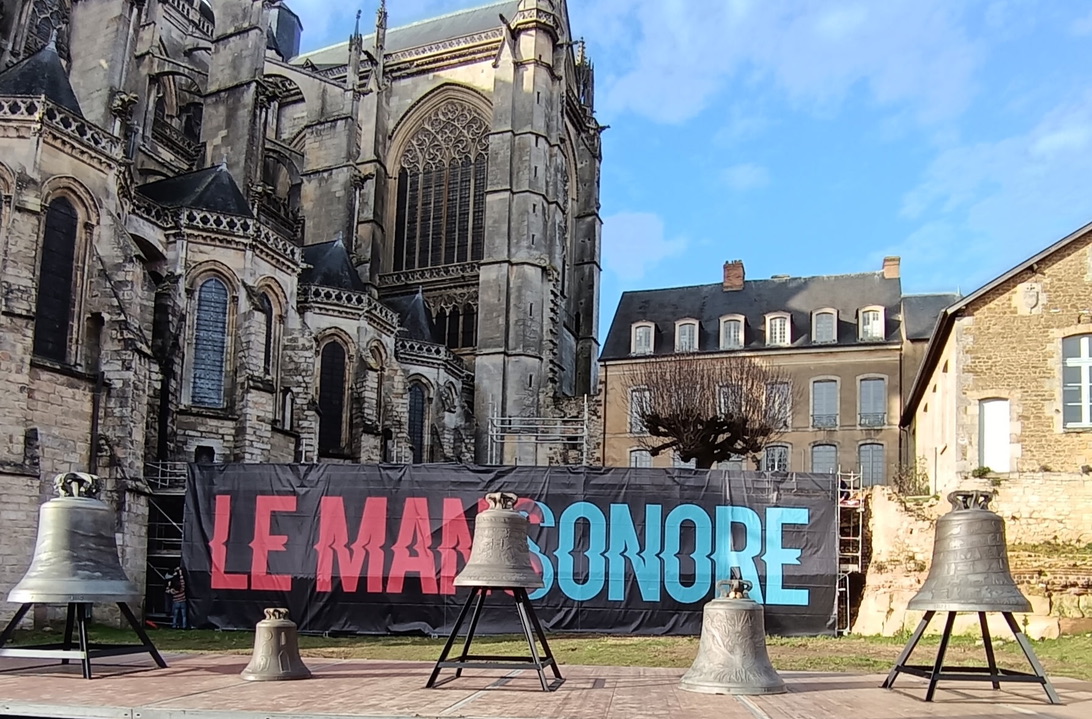
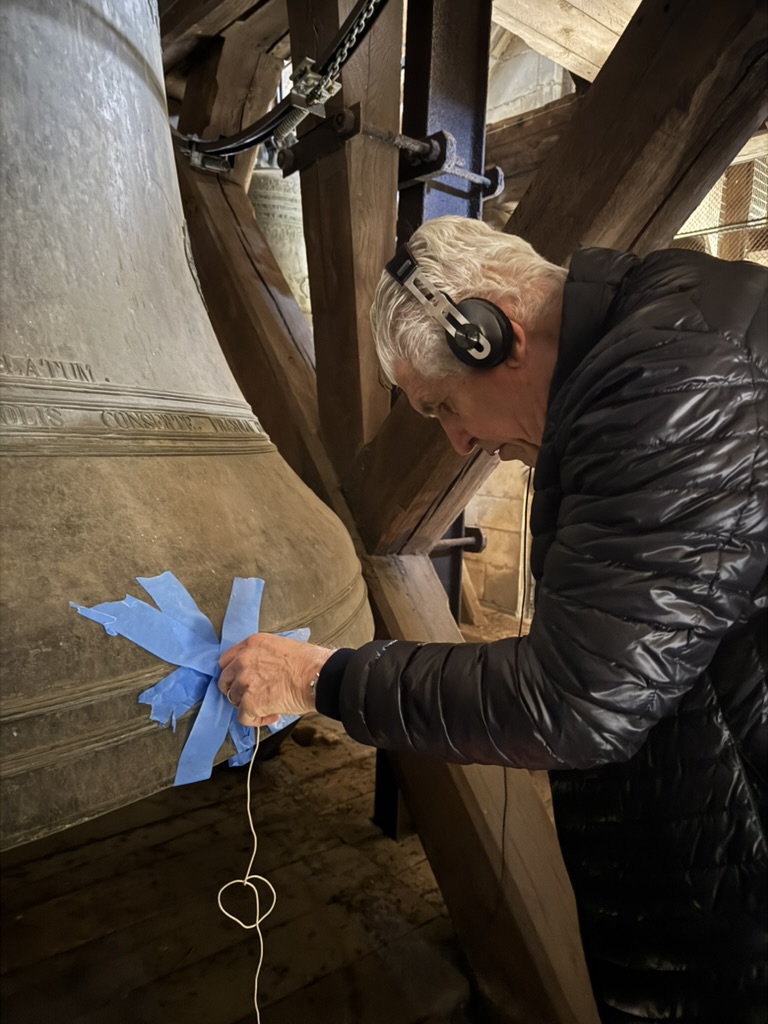
The bells are, in a sense, like ears, sensitive to every sound that occurs around them. To reveal these normally inaudible vibrations, very high-precision seismic accelerometers are fixed inside the bells. These ultra-sensitive sensors respond to the vibrations of the bells as they are set resonating by everything that makes sound and noise around them. The result is a continuous halo of sound, constantly evolving with the changes in the sound environment, the rain, the wind…
So the bells constantly generate a low tone, with overtones that follow their own spectral structure and vary with the intensity and frequency of the ambient sounds around them. The dull, constant, nearby rumble of traffic excites the low frequencies of the bell’s vibration, while high-pitched sounds, such as the carillon of Saint-Julien Cathedral or car horns, bring out the highest overtones. This phenomenon of vibration endlessly producing sound evokes the ancient mystical idea of an eternal music of the spheres arising from the environment, the world or the universe.
These sound vibrations, the resonances picked up by the sensors, are then amplified, distributed and spatialised over some thirty loudspeakers arranged in a circle, as if to recall the shape of a gigantic bell on the Esplanade des Jacobins.
Separating a sound, in real time, from its original source and carrying it to another place close by leads us to charge that sound with a mysterious meaning. Transmitting a sound from an identifiable source to another place can recall the original function of that space, bringing it back to life like the shared memory of a historical past.
« Ce qui est très spécial pour moi dans l’interaction et l’accordage de cette installation, c’est que ces cloches ne se contenteront pas seulement de faire résonner harmonieusement les sons ambiants depuis les jardins de la cathédrale mais qu’elles sont diffusées en temps réel par une installation de haut-parleurs sur la grande esplanade des Jacobins, dans le centre-ville du Mans, ce qui permettra de percevoir directement la relation entre les sons ambiants amplifiés par le spectre harmonique des cinq cloches et le nuage sonore spatialisé qui en résulte. Dans les installations précédentes de Silent Echoes, cette relation directement perceptible entre les sons ambiants et le nuage sonore harmonique qui en résulte n’était pas aussi directement perceptible. Au Mans, le fait que ces cloches « écoutent » pour faire de la musique sera clairement perceptible ».
Bill Fontana’s art can be seen as a complex dialectical relationship between the naturalism of representational art and Marcel Duchamp’s strategy of the ‘found’ object, so dear to Fontana’s mentor John Cage. By removing an ordinary everyday object from its usual context, designating it as a work of art and placing it in a museum, Duchamp gave it a new sense and a new meaning. Fontana does the same with sounds, moving them away from their original source and primary function to charge them with another, memorial symbolism, pointing to the impermanence of all things and to the fragility of these imposing, massive bronze bells, recently recast for the Abbey of Fontevraud in memory of those destroyed during the French Revolution.
The sound environments created by Bill Fontana renew our awareness of the places we inhabit and of the powerful role sound plays for us, both in self-awareness and in memory. Fontana’s projects seek to arouse a dynamic sense of the natural environment, a continuous and invigorating presence that revives our awareness of the narrative envelope that sounds form around our lives. At a first level, his work rests on a careful investigation of the way we perceive sounds in reality.
Throughout his career, Fontana has created a series of projects that subtly address the interplay between the origins of sounds and the context in which they are perceived. In doing so, he invites the listener to become aware of themselves and their sensations, and so to perceive their everyday world anew.
The versions of Silent Echoes
Originally, Silent Echoes Le Mans was a sound sculpture created in 2022, commissioned by the Centre Pompidou and Ircam for the ManiFeste festival under the title Silent Echoes, Notre-Dame. In Paris, throughout the restoration of Notre-Dame after the 2019 fire, the cathedral’s ten bells had fallen silent. Silent Echoes then sought to make audible a secret scene at Notre-Dame: even silent, the ten bells never stop vibrating. Thanks to ultra-sensitive vibration sensors – seismic accelerometers – fitted to the great bells, the acoustic image of the cathedral and the imprint of a city were revealed and projected elsewhere, from the south terrace on level 5 of the Centre Pompidou, facing the two towers of Notre-Dame.
Since then, the installation has gone through several versions: the project moved to the Dachstein ice caves in Austria for the Goiserer Musiktage, as part of the European Capital of Culture 2024. The sound of the bells echoed that of the melting glacier, highlighting the fragility of both monuments and warning us of the dangers of global warming. In this way the pair forms a “sound bridge”, to be relayed to various venues and cultural events across Europe and beyond.
Silent Echoes then travelled to Asia, to Taiwan, before a version for the Vatican entitled Great Bell was installed in the great entrance of St Peter’s Basilica; the work then came to Le Mans, to the Esplanade des Jacobins.
In a future version, Silent Echoes will travel to the United States, to Philadelphia, to the cracked bell known as the Liberty Bell – symbol of the signing of the Declaration of Independence on 4 July 1776 – for its 250th anniversary.
Bill Fontana
Born in 1947 in Cleveland, Ohio, Bill Fontana studied music and philosophy at the New School for Social Research in New York. A decisive encounter with the composer John Cage, who taught him his conception that “everything is music” – that any sound event can be considered music – was a true revelation for the young artist. He then travelled to Australia, Japan and Germany before devoting himself to composition. He began creating sound sculptures in 1976.
Over a career now spanning 55 years, Bill Fontana has built an international reputation through his pioneering experiments with sound. Since the late 1960s, he has consistently used sound as a sculptural medium to interact with, and transform, the perception of visual and architectural spaces.
Drawing on his background in composition, he extracts sound patterns from the natural and man-made world to create sound works that can evoke visual images in the listener’s mind. He has created sound sculptures and radio projects for institutions, museums and broadcasters around the world.
Fontana’s projects have explored hybrid listening technologies using acoustic microphones, underwater sensors (hydrophones) and structural/material sensors (accelerometers).
His work has been exhibited at the Whitney Museum of American Art, New York; the San Francisco Museum of Modern Art; the Museum Ludwig, Cologne; the Post Museum, Frankfurt; the Art History and Natural History Museums, Vienna; Tate Modern and Tate Britain, London; the 48th Venice Biennale; the National Gallery of Victoria, Melbourne; the Art Gallery of New South Wales, Sydney; MAXXI, Rome; and MAAT, Lisbon. He has made many works for radio, an ideal medium for his artistic language, for the BBC, the European Broadcasting Union, the Australian Broadcasting Corporation, National Public Radio, West German Radio (WDR), Swedish Radio, Radio France and Austrian State Radio. His best-known works include Distant Trains, Satellite Ear Bridge Cologne-San Francisco, The Sound of an Unblown Flute, Panoramic Echoes and Acoustical Visions of the Golden Gate Bridge as well as the series Silent Echoes.
Co-production: Ircam Centre Pompidou,
Ingénieur du son : Luca Bagnoli, Lucas Ciret
Computer music designer: Dionysios Papanicolaou
Video design: David Moreau