My Name Is Oona
Gunvor Nelson, 1969
Through its intimacy with nature, Oona evokes the world of memories, the reminiscences of a carefree childhood embodied by the play of a little girl who comes to life in front of Gunvor Nelson’s camera. She meets and becomes friends with Steve Reich at the San Francisco Mime Troup where, alongside her husband, the filmmaker Robert Nelson, she takes part in the artistic activities of this contemporary theatre company in search of new forms. In this context, from 1964, Steve Reich took part in the making of two films by Robert Nelson, The Plastic Haircut and Oh Dem Watermelons. In the latter film, he works from a song on the theme of the watermelon, a popular song that gradually turns into a surprising repetitive music to accompany the misadventures of a watermelon, in a rather “humorous” register while foreshadowing the rhythmic vocal polyphonies that Steve Reich would develop in the 1970s.
To return to My Name is Oona, Gunvor Nelson thus asks Steve Reich to compose an original music, which he conceives solely from real recordings recomposed on magnetic tape.
From the outset, the film shows a strong audiovisual relationship. After the credits, where one can read the title, “My Name is Oona” on a black background, silence continues over the first close-up images of a blonde little girl who is wriggling about. She addresses the camera in silence, and it is at this moment that the soundtrack bursts in, out of sync, to let us hear the recording of a little girl who declares with gusto “My Name is Oona”.
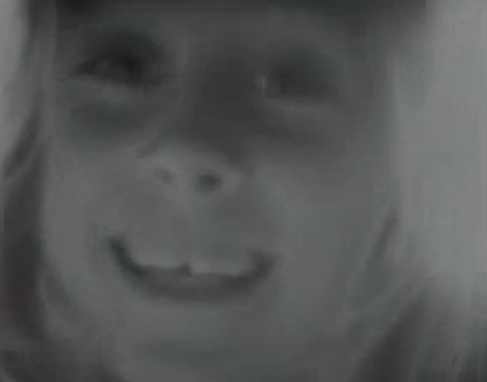
Although the voice is desynchronised, the link between the title, the first images and the soundtrack, far from creating an audiovisual rupture, on the contrary only reinforces it.
From this standard recording, Steve Reich ultimately keeps only the fragment “Oona”. Isolated, looped, then repeated insistently, gradually transforming because of the phase-shift created between the two tape recorders on which this same fragment is played at the same time.
This way of beginning his music cannot fail to refer directly to his sonic experiments of the same period, notably as regards the use of the loop, then the phase-shifting of these loops, like the works composed on the same principle: It’ Gonna Rain (1965) and Come Out (1966).
The choice of these sound elements echoes the very theme of the film, memory. The recording fixes the instant, before the time of listening again transforms it into a memory, a sonic reminiscence.
To accompany these images of resurfaced memories, a little girl’s voice is thus recorded, with the particular patina of optical sound. Perhaps it is the voice of the child who appears on screen? perhaps it is the voice of Oona, probably. Who is Oona? The film does not say. “It’s a memory from another time”, Chris Marker would say… we shall never know.
The images offer a striking contrast with the loops of the music, where Nelson works more at the level of superimposition than of repetition. At the beginning, then, a little girl in close-up, then branches and leaves undulating in the sun in the wind, then, again, the face of another young girl.
The second part appears with a new documentary sound, raw, in which the little girl’s voice, encouraged by her family, one supposes, announces the days of the week in English. Other recordings of this same child follow, in which she says “My Name is Oona” in every possible tone. Reich then proceeds to a slow accumulation and superimposition in this new manner until slowly creating a gigantic reverberating polyphony that intensifies before disappearing to give way delicately to the song of a lullaby sung by the loving voice of a mother humming for her child.
A fascinating film!
My Name is Oona is not an aesthetically isolated work; similar principles of audiovisual composition can be found in other experimental films of the same period: Berlin Horse (1970) by Malcom LeGrice, to a music by Brian Eno, or T O U C H I N G by Paul Sharits, in which the word “destroy” is repeated tirelessly.