Wavelength
Michael Snow, 1966-67
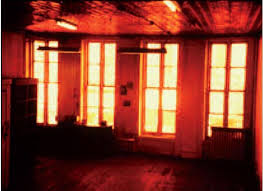
Thanks to Wavelenght (1966-67), which won the Grand Prix at the Knokke-le-Zoute International Experimental Film Festival in 1968, Michael Snow gained real renown as a filmmaker. The first minutes of Wavelenght show a room in a long shot, seen from slightly above, in a studio: at the back of the room a desk and its chair, equipped with a radio and a telephone; opposite, another chair with a few photos pinned to the wall above it. The wall is pierced by two large windows overlooking the street. The floor is covered with floorboards, and on the ceiling two neon tubes light the room.
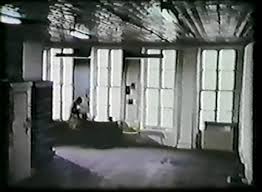
Two men come to set down a shelf: the sound is synchronous; the noises of the street are heard in synchronisation. We are in reality. But then something happens: the image moves, gradually, the frame tightens, we approach the windows. As Michael Snow puts it, “a slow zoom movement traces out before the spectator the spectator’s own destiny and the destiny of the film”. The synchronous sound is replaced by a drone, a sine wave that no rhythm disturbs, which moves very gently towards the high register and from then on covers the whole film. A slow progression climbs the frequencies of the sound spectrum from four thousand to twelve thousand Hz.
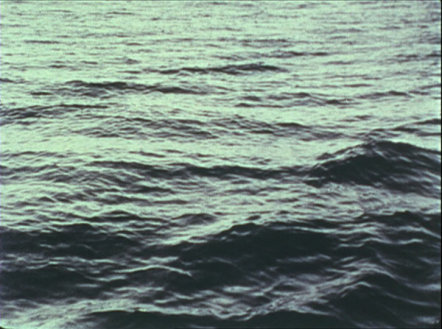
While the zoom tightens, the room passes through day and then night. Temporality is upset; several small, distinct scenes take place, including a murder heard off-screen as well as several people moving house. These sketches are not linked to one another on the narrative level. Tirelessly the zoom continues for more than 40 minutes, crossing the whole room to end on a tight shot of a photograph of waves hanging on the wall between the two windows, next to the portrait of a Walking Woman.
In an interview, Michael Snow confided that he had sought to find a sound equivalent for the movement of the camera zoom. At the outset, he had thought of playing on the dynamics of sound and creating a crescendo, starting from a very faint sound and ending in a very loud one. But the length of the film, forty minutes, did not allow this idea to be realised. He then had the idea of creating a sound that could pass through all the frequencies of the spectrum within the limits of the bandwidth of the optical track. “There is something like a cosmic effect that appears in this idea, rather like the subject of the film, which questions the reality of cinematic representation.” Michael Snow seeks to set the truth of image and sound against the truth of the illusion on the screen. The film steers the spectator towards this question: “If it is not a room that I see on the screen, then what is it?”
Between this sound frequency and the photograph of the waves, a semantic connection is first made through the word Wave. Wavelenght indeed means both “wavelength” and, literally, “wave duration”, in other words the time it takes to reach the waves or, more metaphorically, the single camera movement hurling itself forward would itself be a wave that breaks for a very long time. “There is also a cosmic force in Wavelenght, something that touches on time at the human scale, but also something that goes beyond it.” The normal flow of time is materialised by the direct sound, whereas temporal dilations are signified only by the ascending frequency. In Wavelenght, the trick employed, which gives the appearance of a regular zoom, is in fact only a succession of filmed scenes and photographic instants linked together. With this device, Michael Snow seeks to touch the very foundations of the seventh art, demonstrating that cinema is nothing other than photography, sound and time.