Arnulf Rainer
Peter Kubelka, 1957
The text and video excerpt below document the book by Philippe Langlois, Les cloches d’Atlantis, Musique électroacoustique et cinéma, Archéologie et histoire d’un art sonore, éditions mf, Paris, 2012.
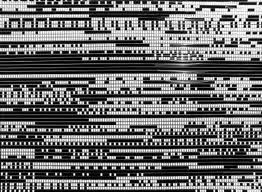
The artist Hermann Nitsch said of Arnulf Rainer that this film represents for cinema what Malevitch’s Carré blanc sur fond blanc represents for painting. Indeed, Arnulf Rainer most certainly represents one of the most radical aspects of experimental cinema; the film is “probably the closest to the essence of cinema because it employs the elements that constitute cinema in their most extreme and purest form”, says Dominique Noguez. The film, lasting six minutes thirty, presents only the four simplest audiovisual figures: the black image, the white image, silence, white noise, and their expansion in time. The whole is of course ordered according to a structural construction that tries to exhaust all the relations capable of uniting these elements.