Night Mail
Basil Wright & Harry Watt, 1936
The text and video excerpt below document the book by Philippe Langlois, Les cloches d’Atlantis, musique électroacoustique et cinéma archéologie et histoire d’un art sonore, éditions mf, Paris, first quarter 2012.
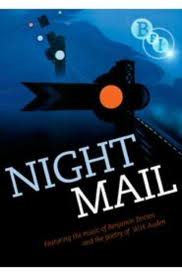
In 1936, Basil Wright and Harry Watt made the corporate documentary Night Mail at the request of the General Post Office, to show the work needed to carry the mail across England. Six million kilometres travelled and 500 million letters delivered every year: such is the mission the postal trains criss-crossing the country must accomplish. Night Mail thus retraces the journey of one of these trains linking London and Glasgow every day, winter and summer alike.
To make this documentary, Basil Wright and Harry Watt put together an exceptional team: the poet Wystan Hugh Auden to write the commentary, and the composer Benjamin Britten to write the music.
From the opening credits, the music plunges the viewer into the world of a marvellous adventure, through the use of a brass section, quivering violins and a small fanfare that unfolds on two notes. These two notes quickly speed up, imitating the noise of the axles of the train setting off, before turning in the strings into a short, very lively melody played in a loop.
The whole film follows this pattern of acceleration until the train reaches the north of Scotland, the last part of its journey. In this final sequence we witness an absolutely successful attempt to unite image, music and Auden’s poetic commentary closely. Each line of the poem reflects what can be seen on screen: the crossing of the moors, the jets of white steam, the mechanical fields and the furnaces of industry.
When the music changes key, the image answers it with a new, less rugged landscape and a different light as dawn approaches. The editing and the diction of the text are then based on the acceleration of the music, shots of connecting rods, axles, points, rails, and the soundtrack becomes a veritable video clip and a rap before its time, signed Benjamin Britten and Wistan Hugh Auden. This editing culminates before the train stops at Aberdeen station, on the last triumphant accents of the music. A work that may surprise given its date of composition: 1936!