Enthusiasm: Symphony of the Donbass
Dziga Vertov, 1931
The text and video excerpt below document the book by Philippe Langlois, Les cloches d’Atlantis, musique électroacoustique et cinéma archéologie et histoire d’un art sonore, éditions mf, Paris, first quarter 2012.
Enthusiasm: Symphony of the Donbass, by Dziga Vertov is not only the first Ukrainian film, it is also the first film to feature a revolutionary treatment of sound in 1930, based on sound manipulation on an optical medium.
In 1930, the Soviet scientist Alexandre Chorine designed for Vertov a sound recording apparatus “manageable” enough to “walk and run” in the street. After a year of study, the first mobile synchronous sound-film station was put into operation in Leningrad. It weighed more than a tonne and had no listening device, so that the directors walked “deaf”, unable to check the quality of the recording. A large part of the sound recordings made by Vertov was unusable because of vibrations that saturated the recording, but the machine noises captured in the Donbass could be used in synchronous sound.
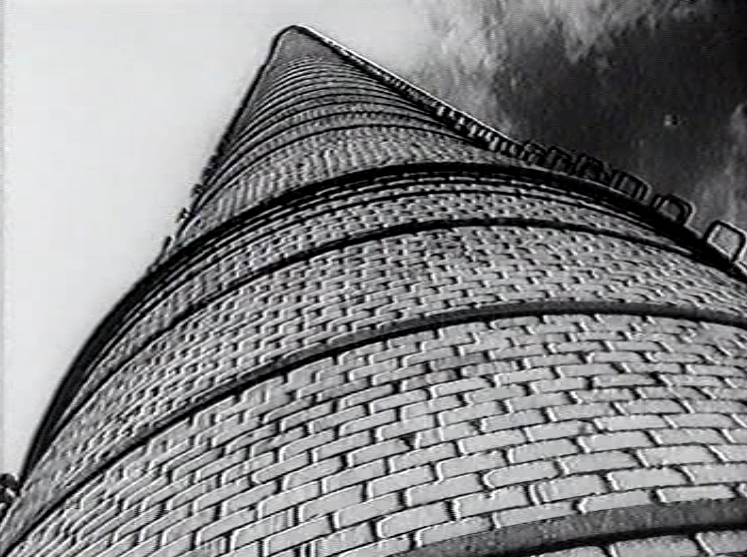
Dziga Vertov does not use just any noise. There is choice, selection, both thematic and qualitative. As with the images, these noises are the expression of a new ruling class. They represent and symbolise the victory of a new world that erases the old world and covers it with its intense dynamism. In the same way, in the unfolding of the film, factory sirens succeed the sound of bells, the collapse of bell towers gives way to industrial construction. It is henceforth the noises of labour and the factory sirens that set the rhythm of daily time, that impose their scansion, their new order.
By making a joyful “popular music” spring from factory noises, Vertov transcends human labour. By an effect of transfer of meaning, he conveys popular “enthusiasm” through collectivism. Vertov transposes Hegel’s theory that defines labour as a liberation of man, and seeks to make it palpable through the work of the noises (coherent, pleasant), concluding with the unifying and universal song of the Internationale, a radiant symbol of Soviet socialism.
In other passages of Enthusiasm, long stretched-out textures, also obtained from the sound of sirens, present minute variations in pitch and let us hear unheard-of sounds made from manipulated concrete sounds. Subtle variations in the tape speed, working from elements that had already been slowed down, also allow him to obtain frequency-modulation effects probably unprecedented in 1930.
Vertov likewise does not refrain from establishing a rhythmic relation in the construction of the sounds and from giving the arrangement of these noises a regular beat. The sound of certain machines, naturally “looped”, thus possesses a real rhythmic value, like fascinating dance rhythms. This arrangement of noises, this general harmony drawn from the operation of the machines, once again relays the idea of a great harmony in labour. The music symbolises joy, harmony and rigour.
When it was released, Enthusiasm was much criticised and did not receive praise from the Soviet press. Dziga Vertov was nevertheless warmly congratulated from London by the filmmaker Charles Chaplin in 1931: “I never would have imagined that industrial noises could be arranged in this way and become so beautiful. I consider Enthusiasm one of the most moving symphonies I have ever been given to hear. Mr Dziga Vertov is a musician”. Chaplin would indeed remember the music of the noises of Enthusiasm when he composed the sound of the factory in Modern Times (1937).
L’Harmattan, Paris, 1998.
Download the volume edited by Jean Pierre Esquenazi, in Google Book: Vertov l’invention du réel