Rapt
Dimitri Kirsanoff, 1934
The text and the video excerpt below document Philippe Langlois’s book, Les cloches d’Atlantis, musique électroacoustique et cinéma archéologie et histoire d’un art sonore, éditions mf, Paris, 2012.
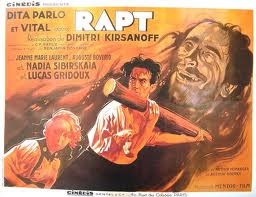
Three years earlier, in 1934, another experiment in retrograde scoring was attempted in the impressive soundtrack of Rapt by Dimitri Kirsanoff, with music jointly composed by Arthur Honneger and Arthur Hoérée. Among the many “sound peculiarities of the film Rapt”, which probably make it the most inventive film in terms of the impressive work on the soundtrack, the use of this process illustrates, this time, a man’s indecision in the face of a vast dilemma.
To represent this man’s waking dream, Arthur Honegger and Arthur Hoérée use the musical process inaugurated by Roland-Manuel in 1929. The unreal and indeterminate sonority of retrograde music once again establishes the link with the character’s interiority. Mixed with the ticking of a clock that marks the time that passes and presses, and with the “voice-over” of the man thinking aloud, the music bathes in a sonic halo, an aspiration, a musical effect that draws him a little further into his indecision. The use of such a process is also a way of making perceptible the possible overturning of Firmin’s life, the unknown of the future.
To create the storm sequence, a panoply of sound effects is needed, on the one hand to reinforce its violence and, on the other, to associate this violence with the scene edited in parallel, that of the kiss Firmin snatches from Elsi. The treatment of sound in this scene is not limited to the intervention of optical synthesis. The special issue of the Revue Musicale of December 1934 echoes this in the authors’ own words:
“To create the storm, we asked the orchestra to improvise, following our indications, some very precisely determined fragments: distant storm, moderate storm, unleashed storm. With these ten metres of film we were able to build, parallel to the action, a complete storm (more than a hundred metres), reproducing one effect, cutting another, editing the rumble of thunder sometimes forwards, sometimes backwards, so that it approaches and recedes (…). The joins between these various fragments were made by means of synthetic sound, that is, by drawing directly on the film the vibrations capable of linking the different sonorities”.
The result of this composition restores, with the image, an authentic audiovisual sensation of violence. The flights of ondes Martenot and the flashes of light blend with the synthetic sounds mixed with the uncertain sonic flows of the orchestral texture to create one of the boldest sound experiments, an example of sound abstraction such as cinema had never engendered before. The tearing, artificial sounds of the lightning punctuate the dialogue in this sequence, the dramatic knot in which the final drama plays out. In the days of the pioneers of sound cinema, it is, to say the least, curious to encounter such a degree of elaboration of sound material in a film of 1933.