Secret Beyond the Door
Fritz Lang, 1948
The text and the video excerpt below document Philippe Langlois’s book, Les cloches d’Atlantis, musique électroacoustique et cinéma archéologie et histoire d’un art sonore, éditions mf, Paris, 2012.
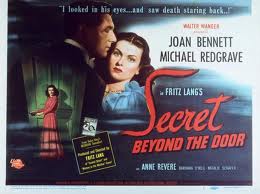
The inversion of acoustic phenomena is very often put to use to signify an atmosphere of strangeness. Using musical retrogradation also allows the composer to instil, almost without the listener’s knowledge, a “surreal” dimension. This is precisely what is at work in Miklos Rozsa’s score for Secret Beyond The Door – Le secret derrière la porte – (1948) by Fritz Lang, whose screenplay borrows several ingredients from Alfred Hitchcock’s Rebecca or Suspicion. After marrying a man she barely knows, Célia discovers that her husband is passionate about rooms in which crimes have been committed. Consumed by this morbid passion, he reconstructs and collects these rooms in his own home. Célia understands what fate awaits her when she discovers, stunned, the exact replica of her own bedroom among her husband’s private collection. The retrograde score comes in at the precise moment when she emerges petrified from this discovery.