The Bride of Frankenstein
James Whale, 1934
The text and video excerpt below document the book by Philippe Langlois, Les cloches d’Atlantis, musique électroacoustique et cinéma archéologie et histoire d’un art sonore, éditions mf, Paris, first quarter 2012.
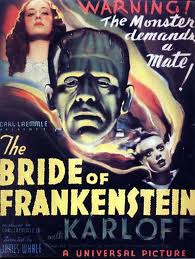
Wishing to complete the fabulous set of Doctor Frankenstein’s laboratory and to represent the terrifying noises of his scientific equipment, James Whale asked Franz Waxman to compose the music for La fiancée de Frankenstein – The Bride of Frankenstein – in 1934, of which he said that “it was a horror film that called for music of haunting strangeness, mysterious and different”. Thus, the theremin, which fulfils the main melodic function, is not the only new acoustic device intended to produce strangeness. Waxman in fact planned a whole rhythmic apparatus combining bowed cymbals and concrete noises – jets of steam, mechanical elements, a grating wheel, etc. – slipping into and marking the rhythmic accents of the great orchestrated theme to simulate the workings of Frankenstein’s laboratory.