Water Walk
John Cage, 1959
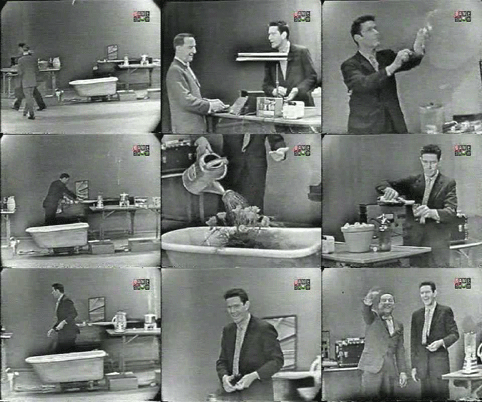
In this video, John Cage appears on the very popular television programme I’ve Got A Secret, created in 1952.
The principle of this television game is to invite two participants per programme, sometimes in the presence of a guest star. Each player is invited to have the audience guess their “ secret ”, after whispering it in the host’s ear, while the description of the famous “ secret ” appears for the television viewers, superimposed on the screen. The audience is invited to guess this “ secret ”, either through its own questions or through those of the host. After a few minutes, the player gives, as far as possible, a demonstration of this “ secret ”.
John Cage, who is then teaching Experimental Composition at the New School in NYC, announces his secret: “ I’m going to perform one of my musical composition… / The instruments I will use are : / a Water Pitcher / an Iron Pïpe, a Goose Call / a Bottle of Wine / an Electric Mixer / a Whistle / a Sprinkling Can / Ice Cubes / 2 Cimbals / a Mechanical Fish / a Quail Call / a Rubber Duck / a Tape Recorder / A Vase of Roses / a Selzer Siphon / 5 Radios / a Bathtub / and A GRAND PIANO. ”
The host, who introduces Cage as “ one of the most controversial artistic figures of his time”, then proposes to skip the game of questions and answers and to offer him a free moment of television to give a “ demonstration ” of his compositional work, which he mistakenly calls “ experimental sound ”. Cage immediately corrects him, specifying: “ experimental music ”, before giving his own definition of music, made from “ sounds ” produced by a series of everyday objects – whose musicality he will have us discover through a performance of the piece Water Walk.
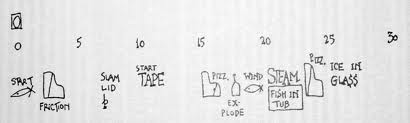
The score indicates to the performer a series of actions to be carried out in a given time, the numbers shown above the actions representing seconds.
There follows a magnificent manifesto by Cage on the place of the spectator. The host warns: “ perhaps some listeners will not be able to bear your music… Perhaps some will even laugh at you”. And Cage replies: “ For me, laughter is comparable to tears ”.
Text by Christophe Kihm and Elie During, originally published on the WFMU blog.