Intonarumori & The Art of Noises
Luigi Russolo, 11 March 1913
Bruitism is a hundred years old…
The term “intonarumori” comes from the contraction of the Italian words intonare (to sing) and rumori (noises), which designates the possibility of making noises sing or intone.
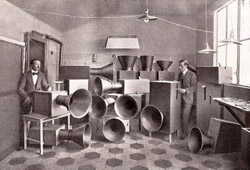
The revolution of the Futurist movement in the musical domain stems from the Bruitism of the painter Luigi Russolo, described in his work The Art of Noises which eloquently completes the Futurist ideas in the domain of timbre. It was allegedly during the Futurist evening of 9 March 1913, at the Teatro Costanzi in Rome, that Luigi Russolo, on hearing Pratella’s symphony L’hymne à la vie, had a “revolutionary intuition”, “Bruitism”: to extend the field of timbre to the use of noise from a musical perspective. We know today that this idea in fact predated the concert of 9 March, and that it was presented as such so as to spare the sensibilities of Pratella, designated as the official Futurist composer. Thus it was that Russolo wrote, two days later, on 11 March 1913, a laudatory “manifesto letter” to Pratella in which one can read:
“(…) Every noise has a tone, sometimes also a chord that dominates the whole of its irregular vibrations. The existence of this predominant tone gives us the practical possibility of intoning noises, that is, of giving a noise a certain variety of tone without losing its characteristic, I mean the timbre that distinguishes it. Certain noises obtained by rotary movement can offer us an entire ascending or descending scale, whether the speed of the movement is increased or decreased. (…)”
(Russolo, The Art of Noises, 11 March 1913)
Here are five examples of Luigi Russolo’s noise-making instruments, in this order: Crepitatore, Ullulatore, Gracidatore, Gorgogliatore, Ronzatore.
A few examples of music that integrate Rossolo’s noise-makers within an instrumental ensemble:
– Corale (1921) by Antonio Russolo, Luigi’s brother, from an original recording of 1921.
– L’aviatore dro opus 33 (1913-14), opera by Francesco Ballila Pratella for soprano and piano in which the use of Russolo’s noise-making instruments is integrated within a classical musical writing.