The Laboratory of Hearing
Dziga Vertov, 1916
DZIGA VERTOV AND THE LABORATORY OF HEARING (1916)
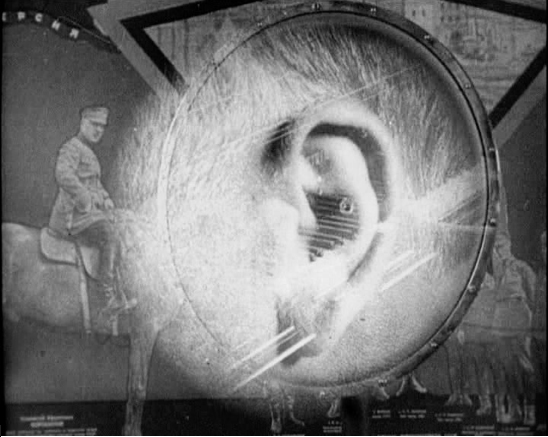
Still from Man with a Movie Camera (1928) © Lobster Film
During the First World War, the Futurist ideas of Mayakovsky and his friends spread to the great Soviet artistic cities such as Petrograd (Saint Petersburg) and influenced a young poet and musician, Denis Arkadievich Kaufman, better known today under the name of Dziga Vertov. In Russian, the first name Dziga is a distortion of Denis and refers to the Ukrainian word meaning spinning top, but also to Tzigane, the eternally wandering people. Vertov derives from the Russian verb “vertet” meaning “to turn, to pivot, to whirl”. Dziga Vertov can thus, surprisingly, take on the meaning of “Perpetual Motion”. At that time Vertov was pursuing studies in medicine and in music in parallel, and greatly admired the Russian Futurists.
“Let us cross a great modern capital together, with our ears more attentive than our eyes…” declares Russolo, a thought that seems also to have driven the Russian filmmaker, although he did not know of the existence of the Futurist musician’s research. In 1916, at the age of twenty, Dziga Vertov founded a “laboratory of hearing” in order to experiment with the montage of sounds by means of the phonograph. In a text entitled “Birth of the Cine-Eye”, published in Articles, journaux, projets, coll. “10/18”, he declares: “And then one spring day in 1918, I come back from the station. I still have in my ears the sighs, the noise of the train pulling away… someone swears… a kiss… someone exclaims… Laughter, whistle, voices, strokes of the station bell, the panting of the locomotive… Murmurs, calls, farewells… I think as I walk: I must finally come up with an apparatus that does not describe but inscribes, photographs these sounds. Otherwise it is impossible to organise them, to edit them. They flee as time flees.” Was he aiming merely to make “sonographies”, or rather to edit, to articulate with one another, to set to rhythm the various noises taken from reality ? No document attests to this to date, apart from the writings of Georges Sadoul, which are rather vague as to the actual work carried out with this sound material.
“Vertov practises the montage of sound elements in this laboratory of hearing, of which he is the only researcher. He has at his disposal a horn Pathéphone, model 1900 or 1910. With this very primitive phonograph Vertov records and combines the sounds of machines, waterfalls and so on, in an attempt to create what we today call musique concrète (…) ”
To carry out his sound experiments, Dziga Vertov logically finds himself obliged to carry his recording apparatus to places chosen for their acoustic quality, then to point the horn of the phonograph towards the coveted source in order to fix its wave motion in the wax of a cylinder or a disc. Thanks to this Pathéphone, which both plays back and records, the young musician records all kinds of diverse noises : mechanical sawmills, torrents, machines in motion, conversation, and so on, then attempting to create, through their arrangement, their montage, their organisation, a sort of new music.
Sadoul unequivocally evokes “the montage of sound elements” and the “combination of sounds”. Yet in 1916 there was only one possibility for producing this type of construction : montage at the source – which can be likened to in-camera editing – where the assembly is carried out at the moment of acquisition, through the successive recording of noises. This is very probably the technique employed by Vertov, to which one may add overlapping (tuilage), technically conceivable through re-recording, although this causes a considerable increase in background noise. Did Vertov imagine the combination of sounds according to a horizontal construction, or did he seek to work vertically in order to create polyphonies of noises ? It is plausible that Vertov, possessing only a single machine, practised montage at the moment of sound recording and could not carry out any re-recording. Moreover, since handling the phonograph allowed no truly precise control of the montage, it is probable that a large part of the elaboration was left to chance, which gives pause as to the quality of the articulations and the musical value of Vertov’s montages. The imprecision of Sadoul’s remarks also shows when he mentions that Vertov “attempted to create what is called musique concrète today”. Although the first years of musique concrète, from 1948 to 1950, were worked out, like Vertov’s experiments in his laboratory of hearing, from the cutting of soft discs, the Etude aux chemins de fer, the first of Pierre Schaeffer’s Etudes de bruits, nevertheless takes into account the possibility of transforming sound in post-production by slowing down, speeding up, reversing and looping, thanks to the closed-groove technique. On this precise point, Georges Sadoul gives no distinct information about the technique adopted by Vertov, nor about the quality of his sound production. Nothing either confirms whether the idea of transforming sounds was envisaged at the moment of recording, or even whether it was envisaged at all.
If Russolo, with his noise-making instruments, concentrates his sound work in a “non-imitative” manner, it is quite otherwise with Dziga Vertov, who conceives noise as a concrete reality. His laboratory of hearing leads him, moreover, to an auditory representation of “truth” through the theory of the “radio-ear”, which he develops out of a rigorous concern to restore an auditory objectivity.
According to Georges Sadoul, Dziga Vertov may, for his experiments, have taken Luigi Russolo’s Art of Noises as a model, but with the fundamental difference that he refused “imitative” instruments in order to use the recording of real sounds. We know today that Vertov had no knowledge of Russolo’s work. Georges Sadoul nevertheless shows that Dziga Vertov used elements expressly catalogued three years earlier by Luigi Russolo such as waterfalls, motors, or mechanical saws. What other natural or urban sounds than those listed by Russolo could attract the curiosity of a Futurist musician like Dziga Vertov without any possible overlap ? Quite clearly, his use of the phonograph – and therefore the fixing of sound on some kind of medium, wax discs, rolls or cylinders – stands out very sharply from the approach of his Italian counterpart, who is intent on reproducing noises mechanically. The use of a recording instrument brings him from the outset a form of “objectivity”, an approach to sound reality that would later become the very definition of his cinematographic approach : Kino Pravda, “cinema-truth”.
Again according to Georges Sadoul, Dziga Vertov also practises in his laboratory of hearing the montage of stenograms and the montage of words, more directly connected with language and poetry, in the same spirit as the “phonographist poets”. This latter technique served him notably in composing certain poems such as Je vois, or Start (1917).
What was the extent of Vertov’s research in this field ? Do fragments of his work still exist ? In what state of preservation? These questions remain for the moment unanswered. It seems that these experiments in the Futurist spirit were rather brief and rudimentary and, for lack of technical means, remained without much musical consequence.
“Working with a wax-disc recorder, Vertov sought to record noises both inside and outside the studio in order to assemble them in entirely new compositions. He was thus attempting to create the concrete symphonies that would be heard in his films of the 1930s, and that would become technically achievable by composers with the introduction of the tape recorder in the 1940s. The result obtained with the equipment available in 1917 must have been discouraging. Ultimately, this stage served as preparation for the disappointed young artist to try another medium”.
These experiments are of great importance as a stage in the development of a creative thought and served as the basis for the filmmaker’s later research. This idea of montage in direct connection with film editing indeed becomes central when Vertov is entrusted, from 1919, with the editing of the newsreels received from all over Russia, where civil war was raging.
Here is a reconstructed excerpt of Vertov’s sound experiments in his laboratory of hearing
Second reconstructed excerpt.